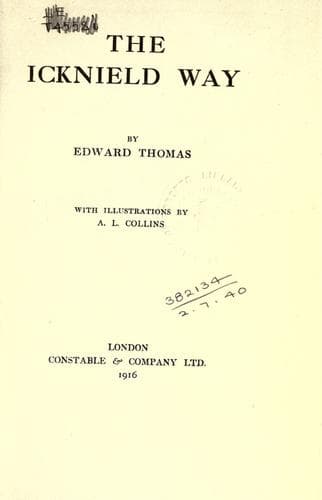
England -- Description and travel; Icknield Way (England); Thomas, Edward, 1878-1917
Sometimes death will give a soul to a house. I once saw the soul of a
dead man given to a new little house with a verandah. The swifts were
racing to and fro between the rows of new houses. They flew just above
the level of men’s hats, except when they turned with a rapier-like
twist up into the air. While they raced they screamed continually
shrill screams of a fierce hilarity. There were half a hundred of them
all flying as upon the surface of an invisible stream surmounted by a
few black, bobbing hats, or, very rarely, an upturned white face; and
no part of the streets was for more than a second without a crescent
black wing and a shriek. They had taken possession of the town. Under
their rush and cry the people in the streets were silent, walking
blankly and straight ahead, and all looking old in contrast with the
tumultuous and violent youth of the birds. The thought came into my
head as I was passing the last of the houses that even so must the
birds have been racing and screaming when the Danes harried this way a
thousand years ago, and thus went they over the head of Dante in the
streets of Florence. In the warriors and in the poet there was a life
clearly and mightily akin to that in the bird’s throat and wing, but
here all was grey, all was dead.
When I came to the bridge leading over the railway to the meadows I
stood and watched the birds flying beneath me, above the slowly curving
metals; for I could not tire of the wings and voices that ripped the
dead air, and I crossed to the other parapet to see how far they went
in the opposite direction. Then for the first time I noticed a house
built almost at the edge of the bank which fell steeply down to the
railway. Only the cutting separated it from the town, and beyond it
could be seen nothing but trees lining the road, and fields on either
side as far as the woods of the horizon. It was the last house of the
town, and one of the newest. Not being in a street it needed not to
be exactly like the rest, square, pierced with oblong windows on two
sides, and blank on the other two; but so it was, except that its
lower windows looked across the railway between the thin, white posts
of a verandah. A strip of garden, not more than equal to it in area,
surrounded the house, and this was enclosed by rusty iron railings
upon all sides. Every window was shut, and the light and air blocked
out by venetian blinds painted grey. The white paint of the window
frames and the verandah was dirty, but the red bricks of the walls
were still harshly new and untouched by vegetation or any stain. The
garden had never been cultivated: it was given over to long grasses of
the unhealthy rankness peculiar to soil which is composed of builders’
refuse, and the stalks were matted and beaten down so as to suggest
the soaked hair of something dead. The door and gate were shut. The
verandah and the white paint gave the building a pretentious air of
being a pleasure house; yet it looked over the railway at the back
Public-domain text, read in full here on John Shaqi.
Reviews
Reviews
No reviews yet
Be the first to share your thoughts on this work.
Elsewhere in the archive
Join the Discussion
Join the discussion
Sign in to leave a comment or review.
Sign InorCreate an account