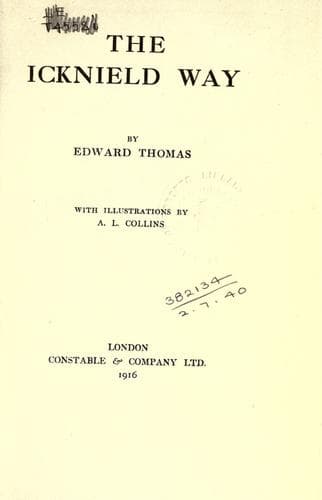
England -- Description and travel; Icknield Way (England); Thomas, Edward, 1878-1917
“Then why doesn’t he go home?” I said, stopping still and thinking
again chiefly of the house.
“His father is dead,” said the little girl and the little boy
simultaneously. Then they went on with their digging, while I turned
and saw the house looking as if it had grown suddenly old in those few
moments--old and haggard, and so cold that I shivered to think how cold
it must be in the death-room behind the venetian blinds. The silence
of the house and road was like a sea suddenly expanding infinitely
about me. As I turned away, the child’s sob, the song of the robin, the
scream of the swifts, fell into that dark silence without breaking it,
like tears into a deep sea. And I looked at the house and saw that the
soul of the dead man had entered it.
[Illustration: The Bridge at Goring.]
Remembering this, I gave up my spiritual frivolity at Cleeve, and
escaped to an inn. I suppose I had been too much taken with churchyard
names in the grey evening to be quite fair to the living landlord
at the inn. He was a short, heavy, fair-haired man, who had a too
distinguished moustache, and talked through his nose, and had a straw
hat tilted back on his neck. He and a wealthy Scotchman were talking
together, and invariably--by a slight effort--agreeing with one
another. His little niece came in with a flag, but he successfully put
her off by saying that he had a lot of things to show her by and by,
and she ran away shouting: “Uncle has a lot of things to show me.”
He explained to the Scotchman that he really had--“flags and things
for the coronation”--“must do something”--“everybody will”--“have
spent half a sovereign”--“it isn’t much--but still....” The child,
he said, was very excitable, not that there was anything wrong; oh,
no; but she would make a wonderful actress. He asked the Scotchman
what he would take, and then ordered two whiskies, which I understood
the other to pay for. They talked of drinks and of champagne, of
course. The landlord began laughing at “some _ladies_” who like it
sweet. He implied huge contempt for a man who could like such stuff.
Nevertheless, he hastened to say: “You don’t like sweet champagne?...
No.... No, of course you don’t.... Oh, yes, well, tastes differ.” This
naturally led to Freemasonry, and it turned out that the Scotchman
had done everything as a Mason (except work in stone); had served
as chairman, etc. etc., and the landlord showed great eagerness of
admiration by saying: “Have you really?” several times. They returned
to the subject of drink. The Scotchman announced that he took nothing
but whisky, except when he had to. The landlord hastened to remark:
“You are quite right. You’ll live the longer for it.” Then the landlord
related how when he was three-quarters drunk he always found it so hard
to drink champagne, which was only good, really, if you were run down,
or for medicinal purposes. A very great deal of natural philosophy was
uttered over those three or four glasses of whisky. After the Scotchman
Public-domain text, read in full here on John Shaqi.
Reviews
Reviews
No reviews yet
Be the first to share your thoughts on this work.
Elsewhere in the archive
Join the Discussion
Join the discussion
Sign in to leave a comment or review.
Sign InorCreate an account