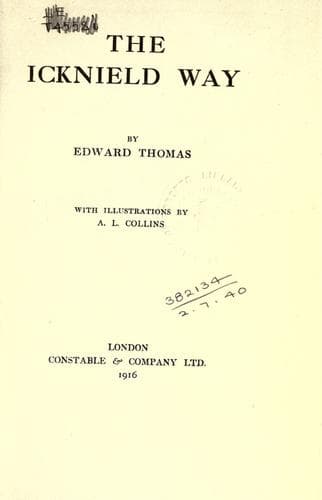
England -- Description and travel; Icknield Way (England); Thomas, Edward, 1878-1917
The road was a dull, straight one going south-westwards over the London
and North Western Railway a mile north of the Upper road, and two and
a half miles north-west of Tring station. It passed allotment gardens
and had the company of heavy-laden telegraph-posts, whose wires cut
across the terraces or “linces” of Southend Hill on the right. But if
the corn-bunting sang its curst dry monotony on the telegraph-wire a
blackbird also sang in an oak. Beyond the railway the road was better
and had level green edges up to the roses of the high hedge on the
right and the low one on the left, over which I could see across the
oats to the Chilterns lying dark under the sun. On the other side of
the barley, which was a cold and bluish green, rose Marsworth Church
tower to the right. The reservoirs beyond the turning to Marsworth were
broad and rough-edged, and with some trimmed poplars at a corner, a
straight rank of trimmed elm trees near the further edge, and the line
of telegraph-wires on this side, they made a foreign scene, against the
background of the Chilterns, of a fascinating dreariness; one man was
fishing from the bank. Crossing the canal I was in Hertfordshire, which
I left at the far side of the last reservoir. These dreary waters had
attracted some thickets which the sedge-warbler loved and sang in, as
by the Wilstone Reservoir. The inns (where they provide for anglers)
and the houses near the locks had the look of canalside and wharfside
settlements, a certain squalor more than redeemed by the individuality.
The unpopulated hills on the left of it, and the Vale of Aylesbury on
the right, emphasized this half-urban, half-marine character. The road
here was very much broken into sharp turns not always by a crossing.
Immediately after the last reservoir, before the turning to Drayton
Beauchamp, the road was at its best, winding between not too level
green edges of unequal breadth, and hedges of thorns and roses and a
few ash trees; and on the edges the grass had been cut and was lying
across the low clover. Doves cooed and a lark overhead sang “as if he
never would be old.” Then, at a bend where a ditch came in and had a
willow above it and some meadow-sweet round about, a sedge-warbler was
singing, the soul of a little world ten yards across. The crossing of
the road to Drayton was one I shall not forget. The signpost pointed
back to Ivinghoe, forward to Aylesbury, Buckland, and Aston Clinton,
on the right to Puttenham, on the left to Drayton. There was a small
crook to the left before my road went forward again. In the midst of
the meeting ways the signpost had a green triangle to stand on. Also,
each road had green borders which all widened to the crossing; some of
the borders had rushes. The road to Puttenham swelled up a little and
fell, and over the rim showed the trees of the vale. Ahead and to the
left were the wooded downs. As I left the signpost I had a very sweet,
gentle-spoken “Good morning” from a traveller coming towards me, a
Public-domain text, read in full here on John Shaqi.
Reviews
Reviews
No reviews yet
Be the first to share your thoughts on this work.
Elsewhere in the archive
Join the Discussion
Join the discussion
Sign in to leave a comment or review.
Sign InorCreate an account