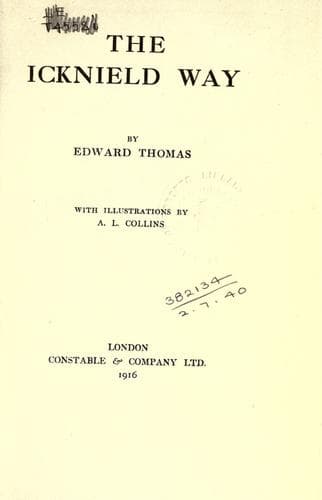
England -- Description and travel; Icknield Way (England); Thomas, Edward, 1878-1917
The word “here” my fancy took quite literally, and I saw a skeleton
cramped behind the tablet protesting to the living that there, inside
the wall, denuded of flesh and of all organs, nerves, and desires, a
wicked man ceased from troubling and a weary one could be at rest; the
teeth of the skeleton shook in their dry sockets as it, now a hundred
and ten years old, uttered those sweet words: “Here the wicked cease
from troubling and the weary are at rest.” Some of the dead outside
bore formidable monosyllabic names, such as Wall, Crook, Saw, and
Cocks. At the “Royal Oak” I listened for half an hour to information
and complaints about the heat, which was at the time about ninety
degrees in the shade, and then went out to make the most of the heat
itself, which I could well do, having myself, as a good critic has
pronounced, an unvarying temperature of about forty-five degrees
(Fahr.).
I left the “Bird in Hand” and a squat, white windmill on the left and
entered a fine green road going straight south-west. One of the hedges
was high enough for shade, in the other some young chestnut trees were
growing up. After some distance the left half of the road was rough and
had a ditch along it; then a tiny stream flowed across, and the way
lost its left hedge and went slightly raised between wheat and oats,
poppy and tall, pale scabious. After that I had clover and bird’s-foot
trefoil and bedstraw and rest-harrow underfoot--corn on the left as far
as elms in masses, and behind these the Chilterns--corn on the right
and ridges of elms beyond. Then another rillet traversed the road and
cooled the feet. In places the grass was very long. Crossing the road
to Kingston Blount the way was more used and rougher; as before it
had corn on both hands--barley and oats speckled like a partridge.
Then a third rillet, and then wheat, barley, oats, and beans in turn;
on the other side of the way wych-elms. There were always elms, and
here and there a farm under them, beyond the corn on the left. Aston
Rowant lay near on my left, with a towered church, a big house, and
men upon a rick, at the edge of the elms. To cross the Aston road my
way made a slight crook to the left and then skirted the hay of Aston
Rowant park, with elms and sweet limes amidst the hay: it was a good
grass and clover track, not deeply rutted. Presently in the mowed and
cleared fields on both sides cattle were walking out from milking.
With another slight crook to the left the way crossed the High Wycombe
and Stokenchurch and Oxford road, where yellow-hammers were singing
in the beeches alongside the telegraph-posts. My way was now a hard
road bordered by beeches and firs, through which I could see the tower
of Lewknor Church across a hayfield. A willow-wren, with a voice like
the sweet voice of someone a thousand years away, was singing among
the tops of the trees. Below, briers and thorns were interwoven, and
silver-weed grew at the edge of the dust. Some country people say
Public-domain text, read in full here on John Shaqi.
Reviews
Reviews
No reviews yet
Be the first to share your thoughts on this work.
Elsewhere in the archive
Join the Discussion
Join the discussion
Sign in to leave a comment or review.
Sign InorCreate an account