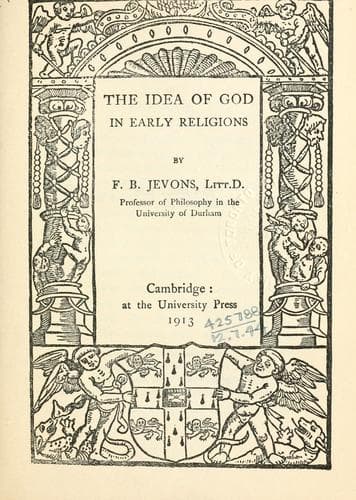
The Idea of God in Early ReligionsJevons, F. B. (Frank Byron)
Religion
The Idea of God in Early Religions
Jevons, F. B. (Frank Byron)
God; Religion
But this is not to say that primitive man argued, or thought, with
never an error, or spoke with never a mistake, until by some
catastrophe he was expelled from some paradise of grammarians and
logicians. Though correct reasoning was logical before the time of
Aristotle, and correct speech grammatical before the time of Dionysius
Thrax; there was before, as there has been since, plenty both of bad
logic and bad grammar. But that is very different from saying that, in
the beginning, all reasoning was unsound, or all speech ungrammatical.
To say so, would be as unmeaning and as absurd as to say that
primitive man's every action was immoral, and his habitual state one
of pure, unmitigated wickedness. If the assumption of a primitive
paradise is unworkable, neither will the assumption of a primitive
inferno act, whether it is for the evolution of the grammar of
language or morality, or of logic or religion, that we wish to
account. It is to ask too much, to ask us to believe that in the
beginning there was only wrong-doing and no right, only error and no
correctness of thought or speech, only spell and no prayer. And if
both have been always, as they are now, present, there must also
always have been a tendency in that which has prevailed to conquer. We
may say that, in the process of evolution, man becomes aware of
differences to which at first he gave but little attention; and, so
far as he becomes conscious of them, he sets aside what is illogical,
immoral, or irreligious, because he is satisfied it is illogical,
immoral, or irreligious, and for no other reason.
The theory that spell preceded prayer in the evolution of religion
proceeds upon a misconception of the process of evolution. At one time
it was assumed and accepted without question that the vegetable and
animal kingdoms, and all their various species, were successive stages
of one process of evolution; and that the process proceeded on one
line and one alone. On the analogy of the evolution of living beings,
as thus understood, all that remained, when the theory of evolution
came to be applied to the various forms of thought and feeling, was to
arrange them also in one line; and that, it was assumed, would be the
line which the evolution of religion had followed. On this assumption,
either magic must be prior to religion, or religion prior to magic;
and, on the principle that priority must be assigned to the less
worthy, it followed that magic must have preceded religion.
Public-domain text, read in full here on John Shaqi.
Reviews
Reviews
No reviews yet
Be the first to share your thoughts on this work.
Elsewhere in the archive
Join the Discussion
Join the discussion
Sign in to leave a comment or review.
Sign InorCreate an account