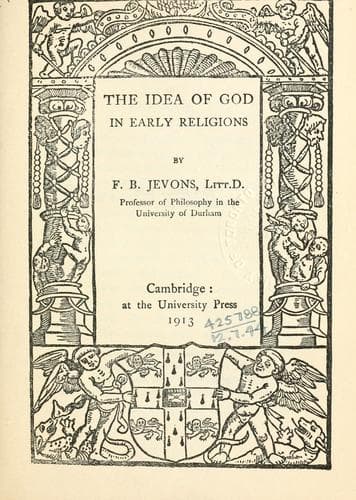
The Idea of God in Early ReligionsJevons, F. B. (Frank Byron)
Religion
The Idea of God in Early Religions
Jevons, F. B. (Frank Byron)
God; Religion
It will scarcely be disputed that it was on the analogy of what was
believed to be the course of evolution, in the case of vegetable and
animal life, that the first attempts to frame a theory of the
evolution of religion proceeded, with the result that gods were
assumed to have been evolved out of fetishes, religion out of magic,
and prayer out of spell. To disprove this, it is not necessary to
reject the theory of evolution, or to maintain that evolution in
religion proceeds on lines wholly different from those it follows
elsewhere. All that is necessary is to understand the theory of the
evolution of the forms of life, as that theory is held by naturalists
now; and to understand the lines which the evolution of life is now
held to have followed. The process of evolution is no longer held to
have followed one line alone, or to have described but one single
trajectory like that of a cannon-ball fired from a cannon. The process
of evolution is, and has been from the beginning, dispersive. To
borrow M. Bergson's simile, the process of evolution is not like that
of a cannon-ball which followed one line, but like that of a shell,
which burst into fragments the moment it was fired off; and these
fragments being, as it were, themselves shells, in their turn burst
into other fragments, themselves in their turn destined to burst, and
so on throughout the whole process. The very lines, on which the
process of evolution has moved, show the process to be dispersive. If
we represent the line by which man has risen from the simplest forms
of life or protoplasm by an upright line; and the line by which the
lowest forms of life, such as some of the foraminifera, have continued
on their low level, by a horizontal line starting from the bottom of
the upright line, then we have two lines forming a right angle. One
represents the line of man's evolution, the other that of the
foraminifera. Between these two lines you may insert as many other
lines as necessary. That line which is most nearly upright will
represent the evolution of the highest form of vertebrate, except man;
the next, the next highest; and so on till you come to the lines
representing the invertebrates; and so on till you come to the lines
which are getting nearer and nearer to the horizontal. Thus you will
have a whole sheaf of lines, all radiating indeed from one common
point, but all nevertheless dispersing in different directions.
Public-domain text, read in full here on John Shaqi.
Reviews
Reviews
No reviews yet
Be the first to share your thoughts on this work.
Elsewhere in the archive
Join the Discussion
Join the discussion
Sign in to leave a comment or review.
Sign InorCreate an account