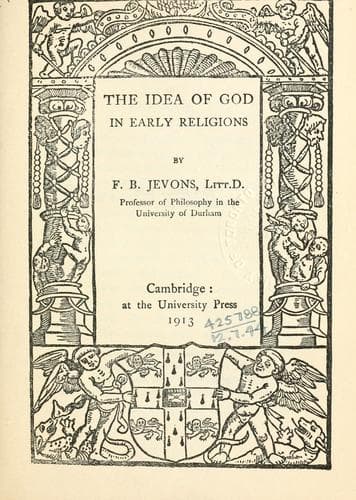
The Idea of God in Early ReligionsJevons, F. B. (Frank Byron)
Religion
The Idea of God in Early Religions
Jevons, F. B. (Frank Byron)
God; Religion
From the point of view of evolution the important fact is that this
new aspect of the idea of God is not something merely superposed upon
the old: if it were simply superposed, it would not be evolved.
Neither is the disclosure, to the soul, of God as love, evolved from
the conception of Him as the being from whom men may seek the
fulfilment of their desires. To interpret the process of religious
evolution in this way would be to misinterpret it, in exactly the same
way as if we were to suppose that, only when the evolution of
vegetable life had been carried out to the full in all its forms, did
the evolution of animal life begin. Animals are not vegetables carried
to a rather higher stage of evolution, any more than vegetables are
animals which have relapsed to a lower stage. If then we are to apply
the theory of evolution to spiritual life, as well as to bodily life,
we must apply it in the same way. We must regard the various forms, in
the one case as in the other, as following different lines, and
tending in different directions from a common centre, rather than as
different and successive sections of one and the same line. Spell no
more becomes prayer than vegetables become animals. Impelled by the
force of calamity to look in one direction--that of deliverance from
pestilence or famine--early man saw, in the idea of God, a refuge in
time of trouble. Moved at a later time by the feeling of gratitude,
man found in the idea of God an object of veneration; and then
interpreted his relation as that of a servant to his lord. Whichever
way this interpretation was pushed--whether to mean that the servant
was to do things pleasing to his lord, in order to gain the fulfilment
of his own desires; or to imply that his transgressions stood ever
between him and his offended master--further advance in that direction
was impossible. A new direction, and therefore a fresh point of
departure, was necessary. It was forthcoming in the Christian idea of
God as the heavenly Father. That idea when revealed is seen to have
been what was postulated but never attained by religion in its earlier
stages. The petitions for our daily bread, for forgiveness of sins,
and for delivery from evil, had as their basis, in pre-Christian
religions, man's desire. In Christianity those petitions are preferred
in the conviction that the making of them is in accordance with God's
will and the granting of them in accordance with His love; and that
conviction is a normative principle of prayer.
V
THE IDEA AND BEING OF GOD
Public-domain text, read in full here on John Shaqi.
Reviews
Reviews
No reviews yet
Be the first to share your thoughts on this work.
Elsewhere in the archive
Join the Discussion
Join the discussion
Sign in to leave a comment or review.
Sign InorCreate an account