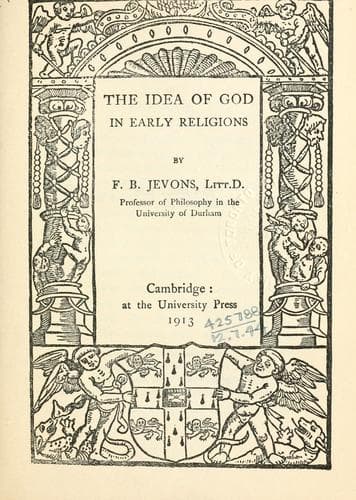
The Idea of God in Early ReligionsJevons, F. B. (Frank Byron)
Religion
The Idea of God in Early Religions
Jevons, F. B. (Frank Byron)
God; Religion
It is in this same process that the evolution of religion consists. It
is the slow process, the gradual recognition, of the fundamental idea
of religion--the idea of God--which tends to rise to the surface of
the religious consciousness. Just as laws of thought, speech and
action are implied by the very conception of right thought or speech
or action, so the idea of God is implied by the mere conception of
religion. It is implied always; it is implicit from the very
beginning. It is disclosed gradually and imperfectly. The process of
disclosure, which is the evolution of the idea, may, in many
instances, be arrested at a stage of very early imperfection, by
causes which make further development in that direction impossible;
and then, if further progress is to be made, a fresh movement, in a
fresh direction must be made. Just as men do not always think
correctly, or act rightly, though they tend, in different degrees, to
do so; so too, in religion, neither do they always move in the right
direction, even if they move at all. They may even deteriorate, at
times, in religion, as, at times, they deteriorate in morality. But it
is not necessary to infer from this undoubted fact that there are no
principles of either morality or religion. We are not led to deny the
existence of the laws of logic or of grammar, because they are
frequently disregarded by ourselves and others.
The principles, or rather some particular principle, of morality may
be absolutely misconceived by a community, at some stage of its
history, in such a way that actions of a certain kind are not
condemned by it. The inconsistency of judgment and feeling, thus
displayed, is not the less inconsistent because it is almost, if not
entirely, unconscious. In the same way a community may fail to
recognise a principle of religion, or may misinterpret the idea of
God; still the fact that they misinterpret it is proof that they have
it--if they had it not, they could not interpret it in different ways.
And the different interpretations are the different ways in which its
evolution is carried forward. Its evolution is not in one continuous
line, but is radiative from one common centre, and is dispersive. That
is the reason why the originators of religious movements, and the
founders of religions, consider themselves to be restoring an old
state of things, rather than initiating a new one; to be returning to
the old religion, rather than starting a new religion. But in point of
fact they are not reverting to a bygone stage in the history of
religion; they are starting afresh from the fundamental principles of
religion. From the central idea of religion, the idea of God, they
move in a direction different from any hitherto followed. Monotheism
may in order of time follow upon polytheism, but it is not polytheism
under another name, any more than prayer is spell under another name.
It is something very different: it is the negation of polytheism, not
another form of it.
Public-domain text, read in full here on John Shaqi.
Reviews
Reviews
No reviews yet
Be the first to share your thoughts on this work.
Elsewhere in the archive
Join the Discussion
Join the discussion
Sign in to leave a comment or review.
Sign InorCreate an account