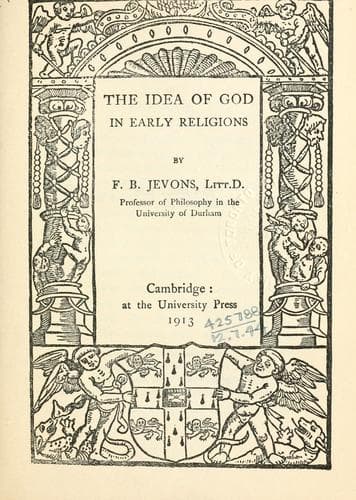
The Idea of God in Early ReligionsJevons, F. B. (Frank Byron)
Religion
The Idea of God in Early Religions
Jevons, F. B. (Frank Byron)
God; Religion
The fact that men fall victims to logical fallacies does not shake our
faith in the validity of the principles of reason; nor does the fact
that false reasoning abounds the more, the lower we descend in the
scale of humanity, lead us to believe that the principles of reason
are invalid and non-existent there. Still less do we believe that,
because immature minds reason often incorrectly, therefore correct
reasoning is for all men an impossibility and a contradiction in
terms. And these considerations apply in just the same way to the
principles of religion and the idea of God, as to the principles of
reason. Yet we are sometimes invited to believe that the existence of
religious fallacies, or fallacious religions, is of itself enough to
prove that there is no validity in the principles of religion, no
reality in the idea of God; that because the uncultured races of
mankind are the victims of error in religion, there is in religion no
truth at all: the religion of civilised mankind consists but of the
errors of the savage disguised in civilised garb. So far as this view
is supposed to be the outcome of the study of the evolution of
religion, it is due probably to the conception of evolution from which
it proceeds. It proceeds on the assumption that the process of
evolution exhibits the continuity of one and the same continuous line.
It ignores the radiative, dispersive movement of evolution in
different lines; and overlooks the fact that new forms of religion
are all re-births, renaissances, and spring not from one another, but
from the soul of man, in which is found the idea of God. It further
assumes not merely that there are errors but that there is no truth
whatever in the lowest, or the earliest, forms of religion; and that
therefore neither is there any truth in the highest. But this
assumption, if applied to the principles of thought, speech or action,
would equally prove thought to be irrational, speech unintelligible,
moral action absurd; and evolution would be the process by which this
fundamental irrationality, unintelligibility and absurdity was worked
out.
Either this is the conclusion, or some means must be sought whereby to
distinguish the evolution of religion from the evolution of thought,
speech and morals, and to show that--whereas in the case of the
latter, evolution is the process in which the principles whereon man
should think, speak and act, tend to manifest themselves with
increasing clearness--in the case of religion, there is no such
progressive revelation, and no first principle, or fundamental idea,
which all forms of religion seek to express. But any attempt to show
this is hopeless: the science of religion is engaged throughout in
ascertaining and comparing the ideas which the various races of men
have had of their gods; and in tracing the evolution of the idea of
God.
Public-domain text, read in full here on John Shaqi.
Reviews
Reviews
No reviews yet
Be the first to share your thoughts on this work.
Elsewhere in the archive
Join the Discussion
Join the discussion
Sign in to leave a comment or review.
Sign InorCreate an account