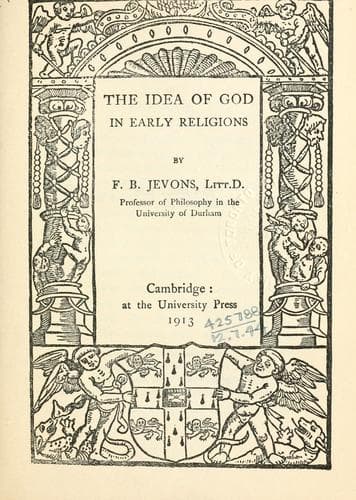
The Idea of God in Early ReligionsJevons, F. B. (Frank Byron)
Religion
The Idea of God in Early Religions
Jevons, F. B. (Frank Byron)
God; Religion
That there may be beings, of whom we have no idea, is a proposition
which it is impossible to disprove. Such beings would be _ex hypothesi_
no part of our experience; and if God were such a being, man would
have no experience of Him. And, having no experience of Him, man could
have no idea of Him. But the experience man has, of those beings whom
he knows, is an experience in which idea and being are given together.
Even if in thought we attend to one rather than to the other of the two
aspects, the idea is still the idea of the being; and the being is
still the being of the idea. So far from there being an impassable gulf
between the two, the two are inseparable, in the moment of actual
experience. It is in moments of reflection that they appear separable
and separate, for the memory remains, when the actual experience has
ceased. We have then only to call the memory the idea, and then the
idea, in this use of the word, is as essentially different from that of
which it is said to be the idea, as the memory of a being or thing is
from the being or thing itself. If we put the memory into words, and
pronounce those words to another, we communicate to him what we
remember of our experience (modified--perhaps transmogrified--by our
reflections upon it) but we do not communicate the actual experience,
simply because we cannot. What we communicate may lead him to actual
experience for himself; but it is not itself the experience. The memory
may give rise, in ourselves or in others to whom we communicate, to
expectation and anticipation; and the expectation is the more likely
to be realised, the less the memory has been transmogrified by
reflection. But, both the memory and the anticipation are clearly
different from actual experience. It is only when they are confused
with one aspect of the actual experience--that which we have called the
idea--that the idea is supposed to be detachable from the being of whom
we have actual experience. The idea is part of the experience; the
memory obviously is not.
If then it be said that the being of God is always an inference and is
never anything more, the reply is that the being of anything whatever
that is remembered or expected is, in the moment of memory or of
anticipation, inferential; but, in the moment of actual experience, it
is not inferred--it is experienced. And what is experienced is, and
from the beginning has always been, in religions of the lower as well
as of the higher culture, at once the being and the idea of God.
INDEX
Aaron, 11
Adoration, 108 ff., 126, 144
Aeschylus, 37
Aetiological myths, 50, 53
Africans, 59
Allegory, 47
Animism, 17, 35, 50
Anthropomorphism, 18 ff., 27
Anti-social character of fetishism, 8, 14
Anu, 136
Aristotle, 121
Assyria, 134 ff.
Atonement, 54, 75
Australians, 57, 58, 59, 86-89, 113, 114
Awe, 24
Axe-heads, 11
Aztecs, 77, 78, 88
Babylonian psalms, 145
Basutos, 143
Being, and idea, 161 ff.
Bergson, 123, 125
Black-fellows, 57
Public-domain text, read in full here on John Shaqi.
Reviews
Reviews
No reviews yet
Be the first to share your thoughts on this work.
Elsewhere in the archive
Join the Discussion
Join the discussion
Sign in to leave a comment or review.
Sign InorCreate an account