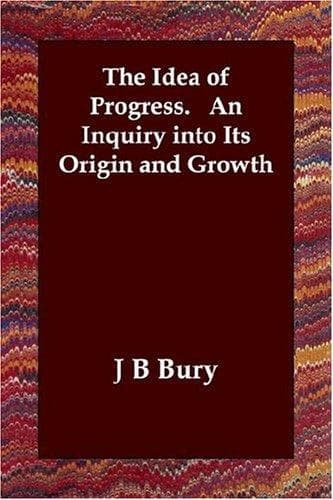
The Idea of Progress: An Inquiry into Its Origin and GrowthBury, J. B. (John Bagnell)
Philosophy
The Idea of Progress: An Inquiry into Its Origin and Growth
Bury, J. B. (John Bagnell)
History -- Philosophy; Progress
The difficulty presented by periods of decadence and barbarism
succeeding epochs of enlightenment is met by the assertion that in
such dark times the world has not stood still; there has really been a
progression which, though relatively inconspicuous, is not unimportant.
In the Middle Ages, which are the prominent case, there were
improvements in mechanical arts, in commerce, in some of the habits of
civil life, all of which helped to prepare the way for happier times.
Here Turgot's view of history is sharply opposed to Voltaire's. He
considers Christianity to have been a powerful agent of civilisation,
not a hinderer or an enemy. Had he executed his design, his work might
well have furnished a notable makeweight to the view held by Voltaire,
and afterwards more judicially developed by Gibbon, that "the triumph of
barbarism and religion" was a calamity for the world.
Turgot also propounded two laws of development. He observed that when a
people is progressing, every step it takes causes an acceleration in the
rate of progress. And he anticipated Comte's famous "law" of the three
stages of intellectual evolution, though without giving it the extensive
and fundamental significance which Comte claimed for it. "Before man
understood the causal connection of physical phenomena, nothing was
so natural as to suppose they were produced by intelligent beings,
invisible and resembling ourselves; for what else would they have
resembled?" That is Comte's theological stage. "When philosophers
recognised the absurdity of the fables about the gods, but had not yet
gained an insight into natural history, they thought to explain the
causes of phenomena by abstract expressions such as essences and
faculties." That is the metaphysical stage. "It was only at a later
period, that by observing the reciprocal mechanical action of bodies
hypotheses were formed which could be developed by mathematics and
verified by experience." There is the positive stage. The observation
assuredly does not possess the far-reaching importance which Comte
attached to it; but whatever value it has, Turgot deserves the credit of
having been the first to state it.
Public-domain text, read in full here on John Shaqi.
Reviews
Reviews
No reviews yet
Be the first to share your thoughts on this work.
Elsewhere in the archive
Join the Discussion
Join the discussion
Sign in to leave a comment or review.
Sign InorCreate an account