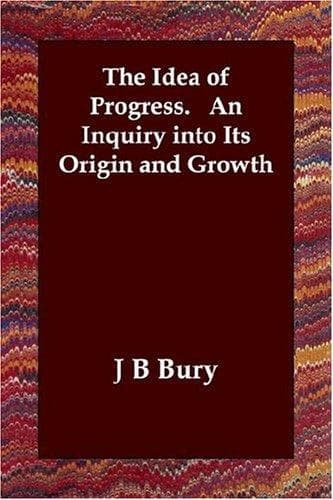
The Idea of Progress: An Inquiry into Its Origin and GrowthBury, J. B. (John Bagnell)
Philosophy
The Idea of Progress: An Inquiry into Its Origin and Growth
Bury, J. B. (John Bagnell)
History -- Philosophy; Progress
If human nature is liable to degenerate, it is capable of proportionable
improvement from the collected wisdom of ages. It is pleasant to infer
from the actual progress of society, the glorious possibilities of human
excellence. And, if the principles can be assembled into view, which
most directly tend to diversify the genius and character of nations,
some theory may be raised on these foundations that shall account
more systematically for past occurrences and afford some openings and
anticipations into the eventual history of the world.]
The problem of dark ages, which an advocate of Progress must explain,
was waved away by Priestley in his Lectures on History with the
observation that they help the subsequent advance of knowledge by
"breaking the progress of authority." [Footnote: This was doubtless
suggested to him by some remarks of Hume in The Rise of Arts and
Sciences.] This is not much of a plea for such periods viewed as
machinery in a Providential plan. The great history of the Middle Ages,
which in the words of its author describes "the triumph of barbarism and
religion," had been completed before Priestley's Lectures appeared, and
it is remarkable that he takes no account of it, though it might seem to
be a work with which a theory of Progress must come to terms.
Yet the sceptical historian of the Decline and Fall of the Roman
Empire, who was more at home in French literature than any of his
fellow-countrymen, was not opposed to the theory of Progress, and he
even states it in a moderate form. Having given reasons for believing
that civilised society will never again be threatened by such
an irruption of barbarians as that which oppressed the arms and
institutions of Rome, he allows us to "acquiesce in the pleasing
conclusion that every age of the world has increased, and still
increases, the real wealth, the happiness, the knowledge and perhaps the
virtue of the human race."
Public-domain text, read in full here on John Shaqi.
Reviews
Reviews
No reviews yet
Be the first to share your thoughts on this work.
Elsewhere in the archive
Join the Discussion
Join the discussion
Sign in to leave a comment or review.
Sign InorCreate an account