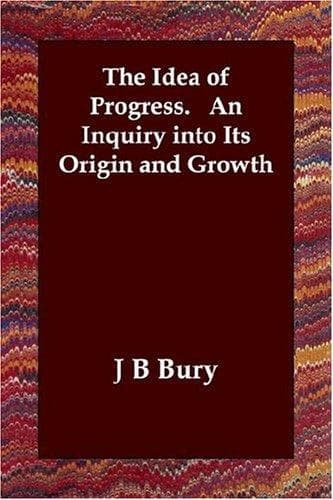
The Idea of Progress: An Inquiry into Its Origin and GrowthBury, J. B. (John Bagnell)
Philosophy
The Idea of Progress: An Inquiry into Its Origin and Growth
Bury, J. B. (John Bagnell)
History -- Philosophy; Progress
Man upon Earth, Parts i.-viii., 1854-55.] proclaimed the approach of an
ideal society in which there will be no ignorance, no poverty, and no
charity--a system "which will ensure the happiness of the human race
throughout all future ages," to replace one "which, so long as it shall
be maintained, must produce misery to all." His own experimental
attempt to found such a society on a miniature scale in America proved a
ludicrous failure.
It is to be observed that in these socialist theories the conception of
Progress as indefinite tends to vanish or to lose its significance. If
the millennium can be brought about at a stroke by a certain arrangement
of society, the goal of development is achieved; we shall have reached
the term, and shall have only to live in and enjoy the ideal state--a
menagerie of happy men. There will be room for further, perhaps
indefinite, advance in knowledge, but civilisation in its social
character becomes stable and rigid. Once man's needs are perfectly
satisfied in a harmonious environment there is no stimulus to cause
further changes, and the dynamic character of history disappears.
Theories of Progress are thus differentiating into two distinct types,
corresponding to two radically opposed political theories and appealing
to two antagonistic temperaments. The one type is that of constructive
idealists and socialists, who can name all the streets and towers
of "the city of gold," which they imagine as situated just round a
promontory. The development of man is a closed system; its term is known
and is within reach. The other type is that of those who, surveying
the gradual ascent of man, believe that by the same interplay of forces
which have conducted him so far and by a further development of
the liberty which he has fought to win, he will move slowly towards
conditions of increasing harmony and happiness. Here the development
is indefinite; its term is unknown, and lies in the remote future.
Individual liberty is the motive force, and the corresponding political
theory is liberalism; whereas the first doctrine naturally leads to a
symmetrical system in which the authority of the state is preponderant,
and the individual has little more value than a cog in a well-oiled
wheel: his place is assigned; it is not his right to go his own way. Of
this type the principal example that is not socialistic is, as we shall
see, the philosophy of Comte.
CHAPTER XIII. GERMAN SPECULATIONS ON PROGRESS
1.
Public-domain text, read in full here on John Shaqi.
Reviews
Reviews
No reviews yet
Be the first to share your thoughts on this work.
Elsewhere in the archive
Join the Discussion
Join the discussion
Sign in to leave a comment or review.
Sign InorCreate an account