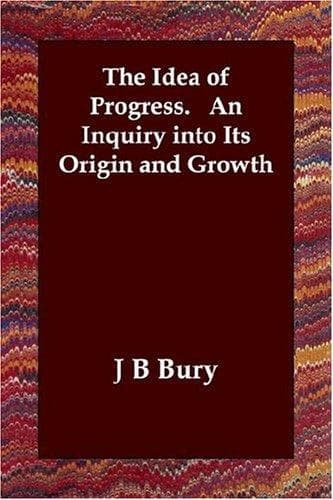
The Idea of Progress: An Inquiry into Its Origin and GrowthBury, J. B. (John Bagnell)
Philosophy
The Idea of Progress: An Inquiry into Its Origin and Growth
Bury, J. B. (John Bagnell)
History -- Philosophy; Progress
The notions of development and continuity which were to control all
departments of historical study in the later nineteenth century were
at the same time being independently promoted by the young historical
school in Germany which is associated with the names of Eichhorn,
Savigny, and Niebuhr. Their view that laws and institutions are a
natural growth or the expression of a people's mind, represents another
departure from the ideas of the eighteenth century. It was a repudiation
of that "universal reason" which desired to reform the world and its
peoples indiscriminately without taking any account of their national
histories.
CHAPTER XV. THE SEARCH FOR A LAW OF PROGRESS:
I. SAINT-SIMON
Amid the intellectual movements in France described in the last chapter
the idea of Progress passed into a new phase of its growth. Hitherto it
had been a vague optimistic doctrine which encouraged the idealism of
reformers and revolutionaries, but could not guide them. It had waited
like a handmaid on the abstractions of Nature and Reason; it had hardly
realised an independent life. The time had come for systematic attempts
to probe its meaning and definitely to ascertain the direction in which
humanity is moving. Kant had said that a Kepler or a Newton was needed
to find the law of the movement of civilisation. Several Frenchmen
now undertook to solve the problem. They did not solve it; but the
new science of sociology was founded; and the idea of Progress, which
presided at its birth, has been its principal problem ever since.
1.
The three thinkers who claimed to have discovered the secret of social
development had also in view the practical object of remoulding society
on general scientific principles, and they became the founders of
sects, Fourier, Saint-Simon, and Comte. They all announced a new era
of development as a necessary sequel of the past, an inevitable and
desirable stage in the march of humanity, and delineated its features.
Comte was the successor of Saint-Simon, as Saint-Simon himself was the
successor of Condorcet. Fourier stands quite apart. He claimed that
he broke entirely new ground, and acknowledged no masters. He regarded
himself as a Newton for whom no Kepler or Galileo had prepared the
way. The most important and sanest part of his work was the scheme for
organising society on a new principle of industrial co-operation. His
general theory of the universe and man's destinies which lay behind
his practical plans is so fantastic that it sounds like the dream of a
lunatic. Yet many accepted it as the apocalypse of an evangelist.
Public-domain text, read in full here on John Shaqi.
Reviews
Reviews
No reviews yet
Be the first to share your thoughts on this work.
Elsewhere in the archive
Join the Discussion
Join the discussion
Sign in to leave a comment or review.
Sign InorCreate an account