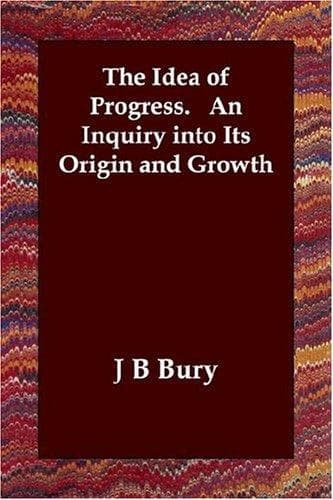
The Idea of Progress: An Inquiry into Its Origin and GrowthBury, J. B. (John Bagnell)
Philosophy
The Idea of Progress: An Inquiry into Its Origin and Growth
Bury, J. B. (John Bagnell)
History -- Philosophy; Progress
Among the competing theories of the time, and sharply opposed to the
views of Comte, was the idea, derived from the Revolution, that the
world is moving towards universal equality and the obliteration of class
distinctions, that this is the true direction of Progress. This view,
represented by leaders of the popular movement against the bourgeois
ascendency, derived powerful reinforcement from one of the most
enlightened political thinkers of the day. The appearance of de
Tocqueville's renowned study of American democracy was the event of
1834. He was convinced that he had discovered on the other side of the
Atlantic the answer to the question whither the world is tending. In
American society he found that equality of conditions is the generating
fact on which every other fact depends. He concluded that equality is
the goal of humanity, providentially designed.
"The gradual development of equality of conditions has the principal
characteristics of a providential fact. It is universal, it is
permanent, it eludes human power; all events and all men serve this
development.... This whole book has been written under the impression of
a sort of religious terror produced in the author's soul by the view
of this irresistible revolution which for so many centuries has been
marching across all obstacles, and which is to-day seen still advancing
in the midst of the ruins it has made.... If the men of our time were
brought to see that the gradual and progressive development of equality
is at once the past and the future of their history, this single
discovery would give that development the sacred character of the will
of the sovran master."
Here we have a view of the direction of Progress and the meaning of
history, pretending to be based upon the study of facts and announced
with the most intense conviction. And behind it is the fatalistic
doctrine that the movement cannot be arrested or diverted; that it is
useless to struggle against it; that men, whatever they may do, cannot
deflect the clock-like motion regulated by a power which de Tocqueville
calls Providence but to which his readers might give some other name.
3.
Public-domain text, read in full here on John Shaqi.
Reviews
Reviews
No reviews yet
Be the first to share your thoughts on this work.
Elsewhere in the archive
Join the Discussion
Join the discussion
Sign in to leave a comment or review.
Sign InorCreate an account