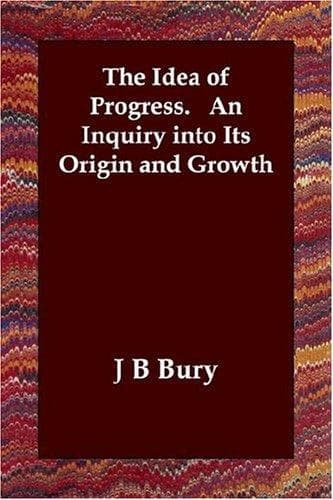
The Idea of Progress: An Inquiry into Its Origin and GrowthBury, J. B. (John Bagnell)
Philosophy
The Idea of Progress: An Inquiry into Its Origin and Growth
Bury, J. B. (John Bagnell)
History -- Philosophy; Progress
Looking back on the course of the inquiry, we note how the history of
the idea has been connected with the growth of modern science, with the
growth of rationalism, and with the struggle for political and religious
liberty. The precursors (Bodin and Bacon) lived at a time when the world
was consciously emancipating itself from the authority of tradition and
it was being discovered that liberty is a difficult theoretical problem.
The idea took definite shape in France when the old scheme of the
universe had been shattered by the victory of the new astronomy and the
prestige of Providence, CUNCTA SUPERCILIO MOUENTIS, was paling before
the majesty of the immutable laws of nature. There began a slow but
steady reinstatement of the kingdom of this world. The otherworldly
dreams of theologians,
ceux qui reniaient la terre pour patrie,
which had ruled so long lost their power, and men's earthly home again
insinuated itself into their affections, but with the new hope of its
becoming a place fit for reasonable beings to live in. We have seen how
the belief that our race is travelling towards earthly happiness was
propagated by some eminent thinkers, as well as by some "not very
fortunate persons who had a good deal of time on their hands." And
all these high-priests and incense-bearers to whom the creed owes its
success were rationalists, from the author of the Histoire des oracles
to the philosopher of the Unknowable.
EPILOGUE
In achieving its ascendency and unfolding its meaning, the Idea of
Progress had to overcome a psychological obstacle which may be described
as THE ILLUSION OF FINALITY.
It is quite easy to fancy a state of society, vastly different from
ours, existing in some unknown place like heaven; it is much more
difficult to realise as a fact that the order of things with which we
are familiar has so little stability that our actual descendants may
be born into a world as different from ours as ours is from that of our
ancestors of the pleistocene age.
The illusion of finality is strong. The men of the Middle Ages would
have found it hard to imagine that a time was not far off in which the
Last Judgement would have ceased to arouse any emotional interest.
In the sphere of speculation Hegel, and even Comte, illustrate this
psychological limitation: they did not recognise that their own
systems could not be final any more than the system of Aristotle or
of Descartes. It is science, perhaps, more than anything else--the
wonderful history of science in the last hundred years--that has helped
us to transcend this illusion.
Public-domain text, read in full here on John Shaqi.
Reviews
Reviews
No reviews yet
Be the first to share your thoughts on this work.
Elsewhere in the archive
Join the Discussion
Join the discussion
Sign in to leave a comment or review.
Sign InorCreate an account