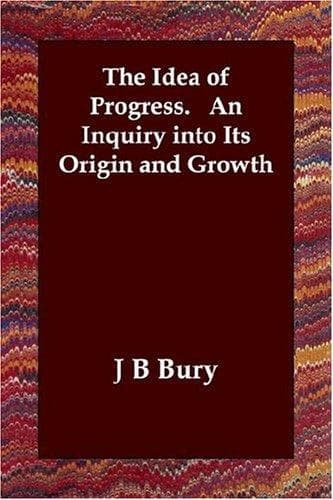
The Idea of Progress: An Inquiry into Its Origin and GrowthBury, J. B. (John Bagnell)
Philosophy
The Idea of Progress: An Inquiry into Its Origin and Growth
Bury, J. B. (John Bagnell)
History -- Philosophy; Progress
plans, Rousseau observed, showed a clear vision of what their effects
would be, "but he judged like a child of means to bring them about." But
his abilities were great, and his actual influence was considerable. It
would have been greater if he had possessed the gift of style.
2.
He was not the first to plan a definite scheme for establishing a
perpetual peace. Long ago Emeric Cruce had given to the world a proposal
for a universal league, including not only the Christian nations of
Europe, but the Turks, Persians, and Tartars, which by means of a court
of arbitration sitting at Venice should ensure the settlement of all
disputes by peaceful means. [Footnote: Le Nouveau Cynee (Paris, 1623).
It has recently been reprinted with an English translation by T. W.
Balch, Philadelphia (1909).] The consequence of universal peace, he
said, will be the arrival of "that beautiful century which the ancient
theologians promise after there have rolled by six thousand years. For
they say that then the world will live happily and in repose. Now it
happens that that time has nearly expired, and even if it is not, it
depends only on the Princes to give beforehand this happiness to their
peoples." Later in the century, others had ventilated similar projects
in obscure publications, but the Abbe does not refer to any of his
predecessors.
He was not blinded by the superficial brilliancy of the reign of Louis
XIV. to the general misery which the ambitious war-policy of that sovran
brought both upon France and upon her enemies. His Annales politiques
are a useful correction to the Siecle de Louis Quatorze. It was in the
course of the great struggle of the Spanish Succession that he
turned his attention to war and came to the conclusion that it is an
unnecessary evil and even an absurdity. In 1712 he attended the congress
at Utrecht in the capacity of secretary to Cardinal de Polignac, one
of the French delegates. His experiences there confirmed his optimistic
mind in the persuasion that perpetual peace was an aim which might
readily be realised; and in the following year he published the memoir
which he had been preparing, in two volumes, to which he added a third
four years later.
Public-domain text, read in full here on John Shaqi.
Reviews
Reviews
No reviews yet
Be the first to share your thoughts on this work.
Elsewhere in the archive
Join the Discussion
Join the discussion
Sign in to leave a comment or review.
Sign InorCreate an account