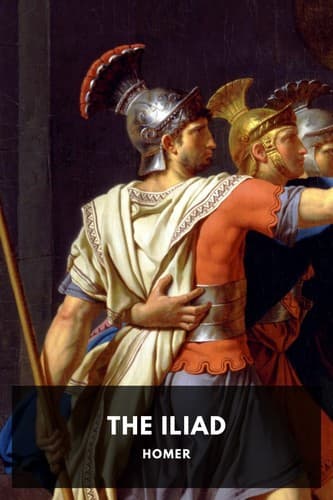
Achilles (Mythological character); Classical literature; Epic poetry, Greek -- Translations into English; Trojan War
“Then was heard the din of battle about the gates of Calydon, and
the dull thump of the battering against their walls. Thereon the
elders of the Aetolians besought Meleager; they sent the chiefest
of their priests, and begged him to come out and help them,
promising him a great reward. They bade him choose fifty
plough-gates, the most fertile in the plain of Calydon, the
one-half vineyard and the other open plough-land. The old warrior
Oeneus implored him, standing at the threshold of his room and
beating the doors in supplication. His sisters and his mother
herself besought him sore, but he the more refused them; those of
his comrades who were nearest and dearest to him also prayed him,
but they could not move him till the foe was battering at the
very doors of his chamber, and the Curetes had scaled the walls
and were setting fire to the city. Then at last his sorrowing
wife detailed the horrors that befall those whose city is taken;
she reminded him how the men are slain, and the city is given
over to the flames, while the women and children are carried into
captivity; when he heard all this, his heart was touched, and he
donned his armour to go forth. Thus of his own inward motion he
saved the city of the Aetolians; but they now gave him nothing of
those rich rewards that they had offered earlier, and though he
saved the city he took nothing by it. Be not then, my son, thus
minded; let not heaven lure you into any such course. When the
ships are burning it will be a harder matter to save them. Take
the gifts, and go, for the Achaeans will then honour you as a
god; whereas if you fight without taking them, you may beat the
battle back, but you will not be held in like honour.”
And Achilles answered, “Phoenix, old friend and father, I have no
need of such honour. I have honour from Jove himself, which will
abide with me at my ships while I have breath in my body, and my
limbs are strong. I say further—and lay my saying to your
heart—vex me no more with this weeping and lamentation, all in
the cause of the son of Atreus. Love him so well, and you may
lose the love I bear you. You ought to help me rather in
troubling those that trouble me; be king as much as I am, and
share like honour with myself; the others shall take my answer;
stay here yourself and sleep comfortably in your bed; at daybreak
we will consider whether to remain or go.”
Public-domain text, read in full here on John Shaqi.
Reviews
Reviews
No reviews yet
Be the first to share your thoughts on this work.
Elsewhere in the archive
Join the Discussion
Join the discussion
Sign in to leave a comment or review.
Sign InorCreate an account