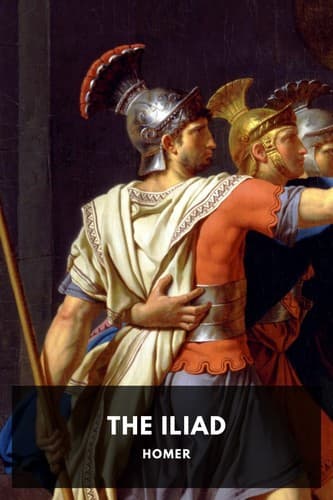
Achilles (Mythological character); Classical literature; Epic poetry, Greek -- Translations into English; Trojan War
With these words he moved the heart of Patroclus, who set off
running by the line of the ships to Achilles, descendant of
Aeacus. When he had got as far as the ships of Ulysses, where was
their place of assembly and court of justice, with their altars
dedicated to the gods, Eurypylus son of Euaemon, met him, wounded
in the thigh with an arrow, and limping out of the fight. Sweat
rained from his head and shoulders, and black blood welled from
his cruel wound, but his mind did not wander. The son of
Menoetius when he saw him had compassion upon him and spoke
piteously saying, “O unhappy princes and counsellors of the
Danaans, are you then doomed to feed the hounds of Troy with your
fat, far from your friends and your native land? Say, noble
Eurypylus, will the Achaeans be able to hold great Hector in
check, or will they fall now before his spear?”
Wounded Eurypylus made answer, “Noble Patroclus, there is no hope
left for the Achaeans but they will perish at their ships. All
they that were princes among us are lying struck down and wounded
at the hands of the Trojans, who are waxing stronger and
stronger. But save me and take me to your ship; cut out the arrow
from my thigh; wash the black blood from off it with warm water,
and lay upon it those gracious herbs which, so they say, have
been shown you by Achilles, who was himself shown them by Chiron,
most righteous of all the centaurs. For of the physicians
Podalirius and Machaon, I hear that the one is lying wounded in
his tent and is himself in need of healing, while the other is
fighting the Trojans upon the plain.”
“Hero Eurypylus,” replied the brave son of Menoetius, “how may
these things be? What can I do? I am on my way to bear a message
to noble Achilles from Nestor of Gerene, bulwark of the Achaeans,
but even so I will not be unmindful of your distress.”
With this he clasped him round the middle and led him into the
tent, and a servant, when he saw him, spread bullock-skins on the
ground for him to lie on. He laid him at full length and cut out
the sharp arrow from his thigh; he washed the black blood from
the wound with warm water; he then crushed a bitter herb, rubbing
it between his hands, and spread it upon the wound; this was a
virtuous herb which killed all pain; so the wound presently dried
and the blood left off flowing.
BOOK XII.
The Trojans and their allies break the wall, led on by Hector.
Public-domain text, read in full here on John Shaqi.
Reviews
Reviews
No reviews yet
Be the first to share your thoughts on this work.
Elsewhere in the archive
Join the Discussion
Join the discussion
Sign in to leave a comment or review.
Sign InorCreate an account