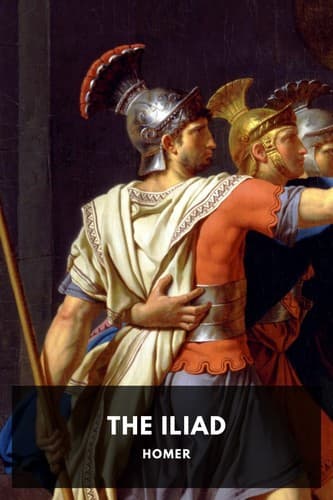
Achilles (Mythological character); Classical literature; Epic poetry, Greek -- Translations into English; Trojan War
As he was thus speaking a bird flew by upon his right hand, and
the host of the Achaeans shouted, for they took heart at the
omen. But Hector answered, “Ajax, braggart and false of tongue,
would that I were as sure of being son for evermore to
aegis-bearing Jove, with Queen Juno for my mother, and of being
held in like honour with Minerva and Apollo, as I am that this
day is big with the destruction of the Achaeans; and you shall
fall among them if you dare abide my spear; it shall rend your
fair body and bid you glut our hounds and birds of prey with your
fat and your flesh, as you fall by the ships of the Achaeans.”
With these words he led the way and the others followed after
with a cry that rent the air, while the host shouted behind them.
The Argives on their part raised a shout likewise, nor did they
forget their prowess, but stood firm against the onslaught of the
Trojan chieftains, and the cry from both the hosts rose up to
heaven and to the brightness of Jove’s presence.
BOOK XIV.
Agamemnon proposes that the Achaeans should sail home, and is
rebuked by Ulysses—Juno beguiles Jupiter—Hector is wounded.
Nestor was sitting over his wine, but the cry of battle did not
escape him, and he said to the son of Aesculapius, “What, noble
Machaon, is the meaning of all this? The shouts of men fighting
by our ships grow stronger and stronger; stay here, therefore,
and sit over your wine, while fair Hecamede heats you a bath and
washes the clotted blood from off you. I will go at once to the
look-out station and see what it is all about.”
As he spoke he took up the shield of his son Thrasymedes that was
lying in his tent, all gleaming with bronze, for Thrasymedes had
taken his father’s shield; he grasped his redoubtable bronze-shod
spear, and as soon as he was outside saw the disastrous rout of
the Achaeans who, now that their wall was overthrown, were flying
pell-mell before the Trojans. As when there is a heavy swell upon
the sea, but the waves are dumb—they keep their eyes on the watch
for the quarter whence the fierce winds may spring upon them, but
they stay where they are and set neither this way nor that, till
some particular wind sweeps down from heaven to determine
them—even so did the old man ponder whether to make for the crowd
of Danaans, or go in search of Agamemnon. In the end he deemed it
best to go to the son of Atreus; but meanwhile the hosts were
fighting and killing one another, and the hard bronze rattled on
their bodies, as they thrust at one another with their swords and
spears.
Public-domain text, read in full here on John Shaqi.
Reviews
Reviews
No reviews yet
Be the first to share your thoughts on this work.
Elsewhere in the archive
Join the Discussion
Join the discussion
Sign in to leave a comment or review.
Sign InorCreate an account