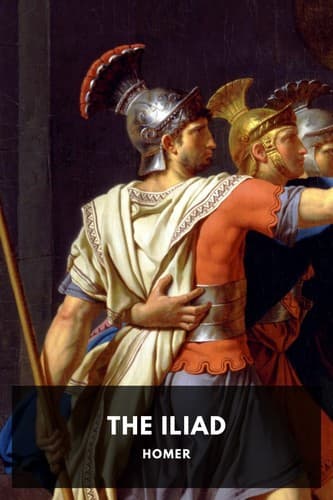
Achilles (Mythological character); Classical literature; Epic poetry, Greek -- Translations into English; Trojan War
The Trojans, fierce as lions, were still rushing on towards the
ships in fulfilment of the behests of Jove who kept spurring them
on to new deeds of daring, while he deadened the courage of the
Argives and defeated them by encouraging the Trojans. For he
meant giving glory to Hector son of Priam, and letting him throw
fire upon the ships, till he had fulfilled the unrighteous prayer
that Thetis had made him; Jove, therefore, bided his time till he
should see the glare of a blazing ship. From that hour he was
about so to order that the Trojans should be driven back from the
ships and to vouchsafe glory to the Achaeans. With this purpose
he inspired Hector son of Priam, who was eager enough already, to
assail the ships. His fury was as that of Mars, or as when a fire
is raging in the glades of some dense forest upon the mountains;
he foamed at the mouth, his eyes glared under his terrible
eyebrows, and his helmet quivered on his temples by reason of
the fury with which he fought. Jove from heaven was with him, and
though he was but one against many, vouchsafed him victory and
glory; for he was doomed to an early death, and already Pallas
Minerva was hurrying on the hour of his destruction at the hands
of the son of Peleus. Now, however, he kept trying to break the
ranks of the enemy wherever he could see them thickest, and in
the goodliest armour; but do what he might he could not break
through them, for they stood as a tower foursquare, or as some
high cliff rising from the grey sea that braves the anger of the
gale, and of the waves that thunder up against it. He fell upon
them like flames of fire from every quarter. As when a wave,
raised mountain high by wind and storm, breaks over a ship and
covers it deep in foam, the fierce winds roar against the mast,
the hearts of the sailors fail them for fear, and they are saved
but by a very little from destruction—even so were the hearts of
the Achaeans fainting within them. Or as a savage lion attacking
a herd of cows while they are feeding by thousands in the
low-lying meadows by some wide-watered shore—the herdsman is at
his wit’s end how to protect his herd and keeps going about now
in the van and now in the rear of his cattle, while the lion
springs into the thick of them and fastens on a cow so that they
all tremble for fear—even so were the Achaeans utterly
panic-stricken by Hector and father Jove. Nevertheless Hector
only killed Periphetes of Mycenae; he was son of Copreus who was
wont to take the orders of King Eurystheus to mighty Hercules,
but the son was a far better man than the father in every way; he
was fleet of foot, a valiant warrior, and in understanding ranked
among the foremost men of Mycenae. He it was who then afforded
Public-domain text, read in full here on John Shaqi.
Reviews
Reviews
No reviews yet
Be the first to share your thoughts on this work.
Elsewhere in the archive
Join the Discussion
Join the discussion
Sign in to leave a comment or review.
Sign InorCreate an account