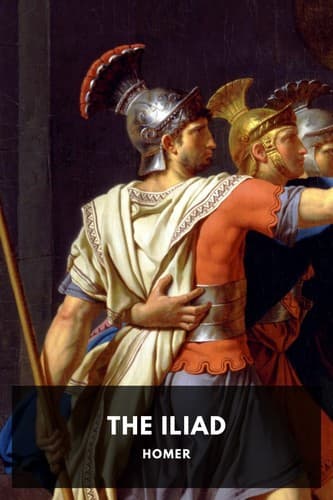
Achilles (Mythological character); Classical literature; Epic poetry, Greek -- Translations into English; Trojan War
two fleet messengers, Death, and Sleep, who will carry him
straightway to the rich land of Lycia, where his brothers and
kinsmen will inter him, and will raise both mound and pillar to
his memory, in due honour to the dead.”
Thus he spoke. Apollo obeyed his father’s saying, and came down
from the heights of Ida into the thick of the fight; forthwith he
took Sarpedon out of range of the weapons, and then bore him a
long way off, where he washed him in the river, anointed him with
ambrosia and clothed him in immortal raiment; this done, he
committed him to the arms of the two fleet messengers, Death, and
Sleep, who presently set him down in the rich land of Lycia.
Meanwhile Patroclus, with many a shout to his horses and to
Automedon, pursued the Trojans and Lycians in the pride and
foolishness of his heart. Had he but obeyed the bidding of the
son of Peleus, he would have escaped death and have been
scatheless; but the counsels of Jove pass man’s understanding; he
will put even a brave man to flight and snatch victory from his
grasp, or again he will set him on to fight, as he now did when
he put a high spirit into the heart of Patroclus.
Who then first, and who last, was slain by you, O Patroclus, when
the gods had now called you to meet your doom? First Adrestus,
Autonous, Echeclus, Perimus the son of Megas, Epistor and
Melanippus; after these he killed Elasus, Mulius, and Pylartes.
These he slew, but the rest saved themselves by flight.
The sons of the Achaeans would now have taken Troy by the hands
of Patroclus, for his spear flew in all directions, had not
Phoebus Apollo taken his stand upon the wall to defeat his
purpose and to aid the Trojans. Thrice did Patroclus charge at an
angle of the high wall, and thrice did Apollo beat him back,
striking his shield with his own immortal hands. When Patroclus
was coming on like a god for yet a fourth time, Apollo shouted to
him with an awful voice and said, “Draw back, noble Patroclus, it
is not your lot to sack the city of the Trojan chieftains, nor
yet will it be that of Achilles who is a far better man than you
are.” On hearing this, Patroclus withdrew to some distance and
avoided the anger of Apollo.
Public-domain text, read in full here on John Shaqi.
Reviews
Reviews
No reviews yet
Be the first to share your thoughts on this work.
Elsewhere in the archive
Join the Discussion
Join the discussion
Sign in to leave a comment or review.
Sign InorCreate an account