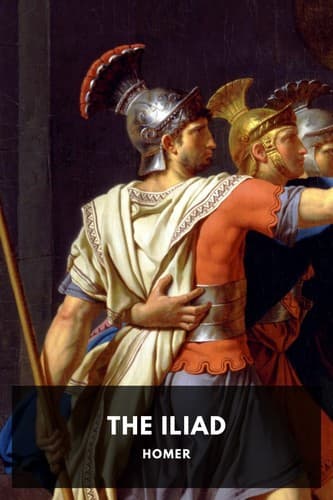
Achilles (Mythological character); Classical literature; Epic poetry, Greek -- Translations into English; Trojan War
On this his mind became clouded; his limbs failed him, and he
stood as one dazed; whereon Euphorbus son of Panthous a
Dardanian, the best spearman of his time, as also the finest
horseman and fleetest runner, came behind him and struck him in
the back with a spear, midway between the shoulders. This man as
soon as ever he had come up with his chariot had dismounted
twenty men, so proficient was he in all the arts of war—he it
was, O knight Patroclus, that first drove a weapon into you, but
he did not quite overpower you. Euphorbus then ran back into the
crowd, after drawing his ashen spear out of the wound; he would
not stand firm and wait for Patroclus, unarmed though he now was,
to attack him; but Patroclus unnerved, alike by the blow the god
had given him and by the spear-wound, drew back under cover of
his men in fear for his life. Hector on this, seeing him to be
wounded and giving ground, forced his way through the ranks, and
when close up with him struck him in the lower part of the belly
with a spear, driving the bronze point right through it, so that
he fell heavily to the ground to the great grief of the Achaeans.
As when a lion has fought some fierce wild boar and worsted
him—the two fight furiously upon the mountains over some little
fountain at which they would both drink, and the lion has beaten
the boar till he can hardly breathe—even so did Hector son of
Priam take the life of the brave son of Menoetius who had killed
so many, striking him from close at hand, and vaunting over him
the while. “Patroclus,” said he, “you deemed that you should sack
our city, rob our Trojan women of their freedom, and carry them
off in your ships to your own country. Fool; Hector and his fleet
horses were ever straining their utmost to defend them. I am
foremost of all the Trojan warriors to stave the day of bondage
from off them; as for you, vultures shall devour you here. Poor
wretch, Achilles with all his bravery availed you nothing; and
yet I ween when you left him he charged you straitly saying,
‘Come not back to the ships, knight Patroclus, till you have rent
the blood-stained shirt of murderous Hector about his body.’ Thus
I ween did he charge you, and your fool’s heart answered him
‘yea’ within you.”
Public-domain text, read in full here on John Shaqi.
Reviews
Reviews
No reviews yet
Be the first to share your thoughts on this work.
Elsewhere in the archive
Join the Discussion
Join the discussion
Sign in to leave a comment or review.
Sign InorCreate an account