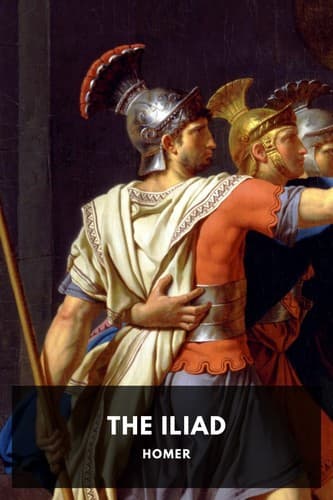
Achilles (Mythological character); Classical literature; Epic poetry, Greek -- Translations into English; Trojan War
To this Menelaus answered in great anger “By father Jove,
boasting is an ill thing. The pard is not more bold, nor the lion
nor savage wild boar, which is fiercest and most dauntless of all
creatures, than are the proud sons of Panthous. Yet Hyperenor did
not see out the days of his youth when he made light of me and
withstood me, deeming me the meanest soldier among the Danaans.
His own feet never bore him back to gladden his wife and parents.
Even so shall I make an end of you too, if you withstand me; get
you back into the crowd and do not face me, or it shall be worse
for you. Even a fool may be wise after the event.”
Euphorbus would not listen, and said, “Now indeed, Menelaus,
shall you pay for the death of my brother over whom you vaunted,
and whose wife you widowed in her bridal chamber, while you
brought grief unspeakable on his parents. I shall comfort these
poor people if I bring your head and armour and place them in the
hands of Panthous and noble Phrontis. The time is come when this
matter shall be fought out and settled, for me or against me.”
As he spoke he struck Menelaus full on the shield, but the spear
did not go through, for the shield turned its point. Menelaus
then took aim, praying to father Jove as he did so; Euphorbus was
drawing back, and Menelaus struck him about the roots of his
throat, leaning his whole weight on the spear, so as to drive it
home. The point went clean through his neck, and his armour rang
rattling round him as he fell heavily to the ground. His hair
which was like that of the Graces, and his locks so deftly bound
in bands of silver and gold, were all bedrabbled with blood. As
one who has grown a fine young olive tree in a clear space where
there is abundance of water—the plant is full of promise, and
though the winds beat upon it from every quarter it puts forth
its white blossoms till the blasts of some fierce hurricane sweep
down upon it and level it with the ground—even so did Menelaus
strip the fair youth Euphorbus of his armour after he had slain
him. Or as some fierce lion upon the mountains in the pride of
his strength fastens on the finest heifer in a herd as it is
feeding—first he breaks her neck with his strong jaws, and then
gorges on her blood and entrails; dogs and shepherds raise a hue
and cry against him, but they stand aloof and will not come close
to him, for they are pale with fear—even so no one had the
courage to face valiant Menelaus. The son of Atreus would have
then carried off the armour of the son of Panthous with ease, had
not Phoebus Apollo been angry, and in the guise of Mentes chief
of the Cicons incited Hector to attack him. “Hector,” said he,
“you are now going after the horses of the noble son of Aeacus,
Public-domain text, read in full here on John Shaqi.
Reviews
Reviews
No reviews yet
Be the first to share your thoughts on this work.
Elsewhere in the archive
Join the Discussion
Join the discussion
Sign in to leave a comment or review.
Sign InorCreate an account