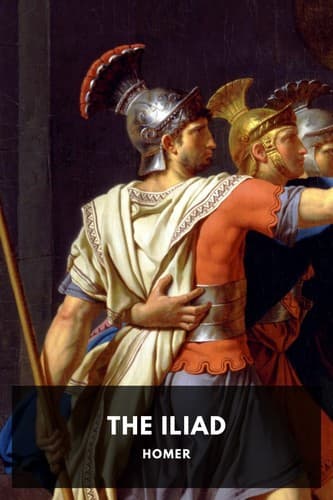
Achilles (Mythological character); Classical literature; Epic poetry, Greek -- Translations into English; Trojan War
In this wise did the two heroes strain every nerve to bear the
body to the ships out of the fight. The battle raged round them
like fierce flames that when once kindled spread like wildfire
over a city, and the houses fall in the glare of its burning—even
such was the roar and tramp of men and horses that pursued them
as they bore Patroclus from the field. Or as mules that put forth
all their strength to draw some beam or great piece of ship’s
timber down a rough mountain-track, and they pant and sweat as
they go—even so did Menelaus and Meriones pant and sweat as they bore the
body of Patroclus. Behind them the two Ajaxes held stoutly out.
As some wooded mountain-spur that stretches across a plain will
turn water and check the flow even of a great river, nor is there
any stream strong enough to break through it—even so did the two
Ajaxes face the Trojans and stem the tide of their fighting
though they kept pouring on towards them and foremost among them
all was Aeneas son of Anchises with valiant Hector. As a flock of
daws or starlings fall to screaming and chattering when they see
a falcon, foe to all small birds, come soaring near them, even so
did the Achaean youth raise a babel of cries as they fled before
Aeneas and Hector, unmindful of their former prowess. In the rout
of the Danaans much goodly armour fell round about the trench,
and of fighting there was no end.
BOOK XVIII.
The grief of Achilles over Patroclus—The visit of Thetis to
Vulcan and the armour that he made for Achilles.
Thus then did they fight as it were a flaming fire. Meanwhile the
fleet runner Antilochus, who had been sent as messenger, reached
Achilles, and found him sitting by his tall ships and boding that
which was indeed too surely true. “Alas,” said he to himself in
the heaviness of his heart, “why are the Achaeans again scouring
the plain and flocking towards the ships? Heaven grant the gods
be not now bringing that sorrow upon me of which my mother Thetis
spoke, saying that while I was yet alive the bravest of the
Myrmidons should fall before the Trojans, and see the light of
the sun no longer. I fear the brave son of Menoetius has fallen
through his own daring and yet I bade him return to the ships as
soon as he had driven back those that were bringing fire against
them, and not join battle with Hector.”
As he was thus pondering, the son of Nestor came up to him and
told his sad tale, weeping bitterly the while. “Alas,” he cried,
“son of noble Peleus, I bring you bad tidings, would indeed that
they were untrue. Patroclus has fallen, and a fight is raging
about his naked body—for Hector holds his armour.”
Public-domain text, read in full here on John Shaqi.
Reviews
Reviews
No reviews yet
Be the first to share your thoughts on this work.
Elsewhere in the archive
Join the Discussion
Join the discussion
Sign in to leave a comment or review.
Sign InorCreate an account