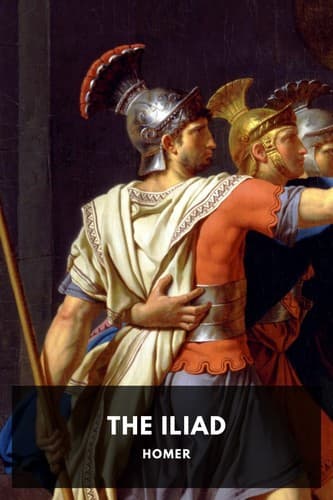
Achilles (Mythological character); Classical literature; Epic poetry, Greek -- Translations into English; Trojan War
“In the beginning Dardanus was the son of Jove, and founded
Dardania, for Ilius was not yet stablished on the plain for men
to dwell in, and her people still abode on the spurs of
many-fountained Ida. Dardanus had a son, king Erichthonius, who
was wealthiest of all men living; he had three thousand mares
that fed by the water-meadows, they and their foals with them.
Boreas was enamoured of them as they were feeding, and covered
them in the semblance of a dark-maned stallion. Twelve filly
foals did they conceive and bear him, and these, as they sped
over the rich plain, would go bounding on over the ripe ears of
corn and not break them; or again when they would disport
themselves on the broad back of Ocean they could gallop on the
crest of a breaker. Erichthonius begat Tros, king of the Trojans,
and Tros had three noble sons, Ilus, Assaracus, and Ganymede who
was comeliest of mortal men; wherefore the gods carried him off
to be Jove’s cup-bearer, for his beauty’s sake, that he might
dwell among the immortals. Ilus begat Laomedon, and Laomedon
begat Tithonus, Priam, Lampus, Clytius, and Hiketaon of the stock
of Mars. But Assaracus was father to Capys, and Capys to
Anchises, who was my father, while Hector is son to Priam.
“Such do I declare my blood and lineage, but as for valour, Jove
gives it or takes it as he will, for he is lord of all. And now
let there be no more of this prating in mid-battle as though we
were children. We could fling taunts without end at one another;
a hundred-oared galley would not hold them. The tongue can run
all whithers and talk all wise; it can go here and there, and as
a man says, so shall he be gainsaid. What is the use of our
bandying hard like women who when they fall foul of one another
go out and wrangle in the streets, one half true and the other
lies, as rage inspires them? No words of yours shall turn me now
that I am fain to fight—therefore let us make trial of one
another with our spears.”
As he spoke he drove his spear at the great and terrible shield
of Achilles, which rang out as the point struck it. The son of
Peleus held the shield before him with his strong hand, and he
was afraid, for he deemed that Aeneas’s spear would go through it
quite easily, not reflecting that the god’s glorious gifts were
little likely to yield before the blows of mortal men; and indeed
Aeneas’s spear did not pierce the shield, for the layer of gold,
gift of the god, stayed the point. It went through two layers,
but the god had made the shield in five, two of bronze, the two
innermost ones of tin, and one of gold; it was in this that the
spear was stayed.
Public-domain text, read in full here on John Shaqi.
Reviews
Reviews
No reviews yet
Be the first to share your thoughts on this work.
Elsewhere in the archive
Join the Discussion
Join the discussion
Sign in to leave a comment or review.
Sign InorCreate an account