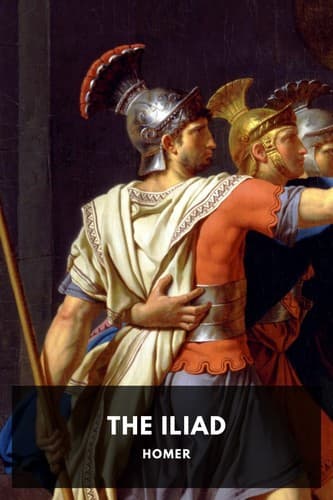
Achilles (Mythological character); Classical literature; Epic poetry, Greek -- Translations into English; Trojan War
Thus did he vaunt, but darkness closed the eyes of the other. The
chariots of the Achaeans cut him up as their wheels passed over
him in the front of the battle, and after him Achilles killed
Demoleon, a valiant man of war and son to Antenor. He struck him
on the temple through his bronze-cheeked helmet. The helmet did
not stay the spear, but it went right on, crushing the bone so
that the brain inside was shed in all directions, and his lust of
fighting was ended. Then he struck Hippodamas in the midriff as
he was springing down from his chariot in front of him, and
trying to escape. He breathed his last, bellowing like a bull
bellows when young men are dragging him to offer him in sacrifice
to the King of Helice, and the heart of the earth-shaker is glad;
even so did he bellow as he lay dying. Achilles then went in
pursuit of Polydorus son of Priam, whom his father had always
forbidden to fight because he was the youngest of his sons, the
one he loved best, and the fastest runner. He, in his folly and
showing off the fleetness of his feet, was rushing about among
front ranks until he lost his life, for Achilles struck him in
the middle of the back as he was darting past him: he struck him
just at the golden fastenings of his belt and where the two
pieces of the double breastplate overlapped. The point of the
spear pierced him through and came out by the navel, whereon he
fell groaning on to his knees and a cloud of darkness
overshadowed him as he sank holding his entrails in his hands.
When Hector saw his brother Polydorus with his entrails in his
hands and sinking down upon the ground, a mist came over his
eyes, and he could not bear to keep longer at a distance; he
therefore poised his spear and darted towards Achilles like a
flame of fire. When Achilles saw him he bounded forward and
vaunted saying, “This is he that has wounded my heart most deeply
and has slain my beloved comrade. Not for long shall we two quail
before one another on the highways of war.”
He looked fiercely on Hector and said, “Draw near, that you may
meet your doom the sooner.” Hector feared him not and answered,
“Son of Peleus, think not that your words can scare me as though
I were a child; I too if I will can brag and talk unseemly; I
know that you are a mighty warrior, mightier by far than I,
nevertheless the issue lies in the lap of heaven whether I, worse
man though I be, may not slay you with my spear, for this too has
been found keen ere now.”
Public-domain text, read in full here on John Shaqi.
Reviews
Reviews
No reviews yet
Be the first to share your thoughts on this work.
Elsewhere in the archive
Join the Discussion
Join the discussion
Sign in to leave a comment or review.
Sign InorCreate an account