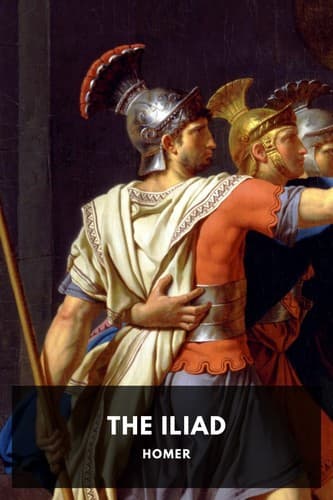
Achilles (Mythological character); Epic poetry, Greek -- Translations into English; Trojan War
“Thou art mad, O Menelaus! offspring of Jove, nor hast thou any need of
such madness: restrain thyself, although grieved, nor wish for the sake
of contention to fight with a braver man than thyself, Hector, the son
of Priam, whom others also dread. Nay, even Achilles, who is much
braver than thou, dreads to meet him 256 in the glorious fight. But
now, going to the troop of thy companions, sit down. Against him the
Greeks will set up some other champion. Although he be intrepid and
insatiable of battle, I think that he will gladly bend his knee, 257 if
he shall escape from the hostile battle and the grievous fight.”
Footnote 256: (return) Lesbonax, περί σχημ. p. 182, reads τούτόν
γε—άντιολήσαι, which Valckenaer, and with reason, thinks a more
_recherché_ and genuine reading than τούτῳ. Lesbonax compares the Attic
phrase άρέσκει με for μοι Cf. Aristoph. Ran. 103, with the Scholiast.
Footnote 257: (return) _I.e._ sit down through fatigue, “de iis qui
longo labore seu cuisu fessi quiescunt et vires recipiunt.”—Heyne.
Thus speaking, the hero dissuaded his brother’s mind, advising him
rightly; and he obeyed. His joyful attendants then stripped the armour
from his shoulders. Then Nestor arose amidst the Greeks, and said:
“O gods, surely great grief comes upon the Grecian land. Certainly the
aged knight Peleus, the excellent counsellor and adviser of the
Myrmidons, will greatly lament, who formerly interrogated me, greatly
rejoiced in his palace, inquiring the race and offspring of all the
Greeks. If he now heard of them all crouching down under Hector, often
indeed would he uplift his hands to the immortals, [praying] that his
soul, [separated] from his limbs, might depart into the house of Pluto.
For would, Ο father Jove, and Minerva, and Apollo, I were young, as
when the assembled Pylians and the spear-skilled Arcadians fought by
the rapid Celadon, at the walls of Phæa, about the streams of Jardan.
With them Ereuthalion, god-like hero, stood in the van, bearing on his
shoulders the armour of king Areïthous, of noble Areïthous, whom men
and beauteous-girt women called by surname Corynetes, since he fought
not with a bow, nor with a long spear, but used to break the phalanxes
with an iron club. Him Lycurgus slew by stratagem, not by strength, in
a narrow defile, where his iron club did not ward off destruction from
him; for Lycurgus, anticipating, pierced him right through the waist
with his spear, and he was dashed to the ground on his back; and he
spoiled him of the armour which brazen Mars had given him, and he
indeed afterwards bore them himself in the battle of Mars. But when
Lycurgus had grown old in his palaces, he gave them to his beloved
attendant Ereuthalion, to be borne: and he, having his armour,
challenged all the bravest: but these trembled and feared very much:
nor did any one dare [to withstand him]. But my bold mind, by its
confidence, urged me on to fight him: now I was the youngest of them
Public-domain text, read in full here on John Shaqi.
Reviews
Reviews
No reviews yet
Be the first to share your thoughts on this work.
Elsewhere in the archive
Join the Discussion
Join the discussion
Sign in to leave a comment or review.
Sign InorCreate an account