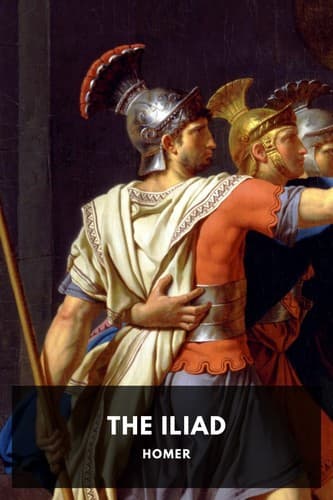
Achilles (Mythological character); Epic poetry, Greek -- Translations into English; Trojan War
He spoke, and brandishing hurled forth his long-shadowed spear, and
smote the mighty seven-hided shield of Ajax on the outside brass, which
was the eighth [layer] thereon. And the unwearied brass cutting
through, penetrated six folds, and was stuck fast in the seventh hide.
Next, Jove-sprung Ajax in turn sent forth his very long spear, and
struck the all-equal shield of Priam’s son. Through the shining shield
passed the impetuous spear, and was fastened in his very
ingeniously-wrought corslet, and from the opposite side the spear cut
his tunic near the flank. But he inclined himself, and avoided black
death. Then they both, having drawn out their long spears with their
hands, joined battle, like unto raw-devouring lions, or wild boars,
whose strength is not feeble. Then indeed the son of Priam struck the
midst of his [Ajax’s] shield with his spear; it broke not through the
brass, but the point of it was bent. But Ajax, bounding forward,
pierced his shield: and the spear went right through, and repelled him
as he rushed on: it glanced over his neck, cutting it, and black gore
gushed forth. But not even thus did crest-tossing Hector cease from the
battle: but retiring back, he seized in his hand, a black, rough, huge
stone, lying in the plain. With it he struck the mighty seven-hided
shield of Ajax, in the midst of the boss, and the brass rang around.
Ajax next taking up a much larger stone, whirling, discharged it, and
applied immense strength. And he broke through the shield, having
struck with a rock like unto a millstone, and he wounded him in the
knee; and he was stretched supine, having come into violent contact
with his shield; but Apollo quickly raised him. And now in close combat
hand to hand, they would have wounded each other with their swords, had
not the heralds, the messengers of gods and men, arrived, one of the
Trojans, the other of the brazen-mailed Greeks, Talthybius and Idæus,
both prudent men. And between both armies they held their sceptres, but
the herald Idæus, skilled in prudent counsels, said:
“No longer, my dear sons, war or fight, for cloud-collecting Jove loves
you both: ye both are warriors, and this we all know. Night is now
approaching, and it is good to obey night.” 259
Footnote 259: (return) Cf. Æn. ii. 8:—
——“et jam nox humida cœlo
Præcipitat, suadentque cadentia sidera somnos.”
But him Telamonian Ajax answering addressed: “Idæus, order Hector to
speak these words, for he challenged all the bravest [of our side] to
battle. Let him begin, and I will entirely obey, if indeed he does so.”
Public-domain text, read in full here on John Shaqi.
Reviews
Reviews
No reviews yet
Be the first to share your thoughts on this work.
Elsewhere in the archive
Join the Discussion
Join the discussion
Sign in to leave a comment or review.
Sign InorCreate an account