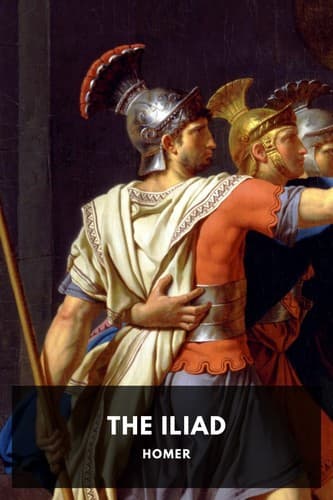
Achilles (Mythological character); Epic poetry, Greek -- Translations into English; Trojan War
Of these let him lead the beloved one, whichsoever he may
choose, without marriage-dower, to the house of Peleus; but I will give
very many dowries, so many as no man ever yet gave to his daughter. I
will, moreover, give him seven well-inhabited cities,—Cardamyle, Enope,
and grassy Ira, glorious Pheræ, with deep-pastured Anthea, fair Æpeia,
and vine-bearing Pedasus; which are all near the sea, the last towards
sandy Pylus. But in them dwell men rich in flocks and herds, who will
honour him like a god with gifts, and beneath his sceptre will pay rich
tributes. These will I bestow upon him, ceasing from his anger. Let him
be prevailed upon. Pluto indeed is implacable and inexorable, wherefore
he is the most hateful of all the gods to men. Let him likewise yield
to me, inasmuch as I am more kingly, and because I boast to be older
[than he].”
But him the Gerenian knight Nestor then answered: “Most glorious son of
Atreus, king of men, Agamemnon, thou indeed offerest gifts by no means
despicable to king Achilles. But come, let us urge chosen men, who may
go with all speed to the tent of Achilles, the son of Peleus. Come
then, these will I select, but let them obey. First of all indeed let
Phœnix, dear to Jove, be the leader; next then mighty Ajax and divine
Ulysses: and of the heralds, let Hodius and Eurybates follow with them.
But bring water for the hands, and command to observe well-omened
words, 297 that we may supplicate Saturnian Jove, if perchance he will
take pity.”
Footnote 295: (return) _I. e_. not yet brought into common use.
Footnote 296: (return) A beautiful expression, denoting the fertility
of the land. Cf. Albert. on Hesych. t. ii. p. 806. So νησοιο μαστός in
Callim. II. in Del. 48.
Footnote 297: (return) The translation, “favour us with their voices,”
is nonsense, while “keep silence” is by no means the meaning of
εύφημήσαι. Kennedy rightly explains it, “abstain from expressions
unsuitable to the solemnity of the occasion, which, by offending the
god, might defeat the object of their supplications.” See Servius on
Virg. Æn. v. 71; Lamb, on Hor. Od. iii. 1, 2; Broukhus. on Tibull. ii.
1, 1.
Thus he spoke, and delivered an opinion agreeable to them all.
Immediately indeed the heralds poured water upon their hands, and the
youths crowned the goblets with wine; then they distributed them to
all, having poured the first of the wine into the cups. But when they
had made libations, and drunk as much as their mind desired, they
hastened from the tent of Agamemnon, the son of Atreus. To them the
Gerenian knight Nestor gave many charges, looking wistfully upon each,
particularly upon Ulysses, that they should endeavour to persuade the
blameless son of Peleus.
Public-domain text, read in full here on John Shaqi.
Reviews
Reviews
No reviews yet
Be the first to share your thoughts on this work.
Elsewhere in the archive
Join the Discussion
Join the discussion
Sign in to leave a comment or review.
Sign InorCreate an account