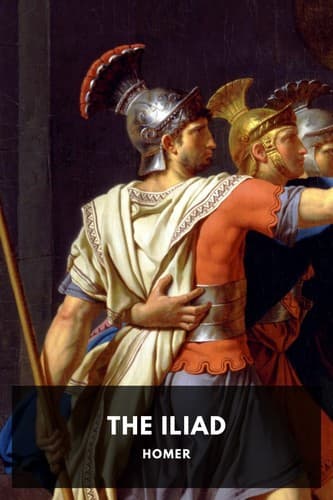
Achilles (Mythological character); Epic poetry, Greek -- Translations into English; Trojan War
my bed, should enjoy the possessions which aged Peleus hath acquired.
For not worth my life are all the [treasures] which they say the
well-inhabited city Ilium possessed, whilst formerly at peace, before
the sons of the Greeks arrived; nor all which the stony threshold of
the archer Phœbus Apollo contains within it, in rocky Pytho. 313 By
plunder, oxen and fat sheep are to be procured, tripods are to be
procured, and the yellow heads of steeds; but the life of man cannot be
obtained nor seized, so as to return again, when once it has passed the
enclosure of the teeth. For my goddess mother, silver-footed Thetis,
declares that double destinies lead me on to the end of death. If, on
the one hand, remaining here, I wage war around the city of the
Trojans, return is lost to me, but my glory will be immortal; but if,
on the other hand, I return home to my dear fatherland, my excellent
glory is lost, but my life will be lasting, nor will the end of death
speedily seize upon me. And to others also would I give advice to sail
home, for ye will not find an end of lofty Ilium; for far-sounding Jove
hath stretched over it his hand, and the people have taken courage. But
do ye, departing, bear back this message to the chiefs of the Greeks,
for such is the office of ambassadors, that they devise within their
minds some other better plan, which for them may preserve their ships,
and the army of the Greeks in the hollow barks; since this, which they
have now devised, is not expedient for them, while I cherish my wrath.
But let Phœnix, remaining here, recline beside us, that to-morrow, if
he will, he may follow me in the ships to my dear fatherland, although
I will by no means lead him away by compulsion.”
Footnote 303: (return) This word is etymologically connected with
τρνγών. It properly signifies the moaning of the dove.
Footnote 304: (return) Schol. περισσόν τί εστι. Kennedy explains it:
“nor have all the toils which I have undergone been productive of any
superior advantage to me.”
Footnote 305: (return) See a list of these cities in Heyne’s note.
Footnote 306: (return) Observe the broken construction, well suited to
the irritability of the speaker.
Footnote 307: (return) Cf. Cicero de Div. i. 25.
Footnote 308: (return) “Εῤῥων, ἐπί φθορᾷ.” (ita etym. magn.)
παραγενόμενος. Cf. Alberti on Hesych. t. i. p. 1445.
Footnote 309: (return) “Εκηλος forcibly expresses the condition of one
who is advancing imperceptibly, though surely, to final ruin.”—Kennedy.
Footnote 310: (return) See Kennedy, and Duport, Gnom. p. 52, who
compare the phrases “pilo minus amare”, “pili facere.” There is,
however, much uncertainty respecting the origin and meaning of the
proverb. Cf. Alberti on Hesych. t. i. p. 1246.
Public-domain text, read in full here on John Shaqi.
Reviews
Reviews
No reviews yet
Be the first to share your thoughts on this work.
Elsewhere in the archive
Join the Discussion
Join the discussion
Sign in to leave a comment or review.
Sign InorCreate an account