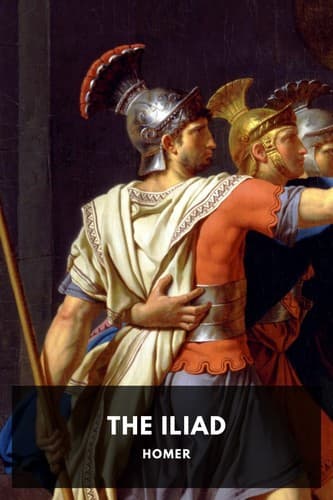
Achilles (Mythological character); Epic poetry, Greek -- Translations into English; Trojan War
Footnote 343: (return) Soph. Aj. 3: Καὶ νῦν ἐπὶ sκηναῖϛ σε ναυτικαῖϛ
ὁρῶ Αἴαντος, ἔνθα τάξιν ἐσχάτην ἔχει.
But him Agamemnon, king of men, in turn addressed: “Old man, at other
times I would even bid thee blame him, for he is frequently remiss, and
is not willing to labour, yielding neither to sloth, nor
thoughtlessness of mind, but looking to me, and awaiting my
commencement. But now he arose long before me, and stood beside me; him
I have sent before to call those whom thou seekest. But let us go, and
we shall find them before the gates among the guards; for there I bade
them be assembled.”
But him the Gerenian knight Nestor then answered: “If so, none of the
Greeks will be angry, nor disobey when he may exhort or give orders to
any.”
Thus saying, he put on his tunic around his breast, and beneath his
shining feet he placed the beautiful sandals, and fastened about him
his purple cloak with a clasp, double, ample; 344 and the shaggy pile
was thick upon it: and he seized a doughty spear, pointed with sharp
brass. He proceeded first to the ships of the brazen-mailed Achæans;
then the Gerenian knight Nestor, vociferating, aroused from his sleep
Ulysses, equal to Jove in counsel. But the voice immediately penetrated
his mind, and he came out from the tent, and addressed them:
“Why, I pray, wander ye thus alone through the ambrosial night, near
the ships, through the army; what so great necessity now comes upon
you?”
Footnote 344: (return) Schol.: Τὴν μεγάλην, ωστε καὶ διπλῇ αὐτή
χρώμενον ἔχειν ἐκτεταμένην. The epithet φοινικόεσσα denotes that it was
the garb of royalty.
But him Nestor, the Gerenian knight, then answered: “Jove-sprung son of
Laertes, much-scheming Ulysses, be not indignant, for so great a sorrow
hath oppressed the Greeks. But follow, that we may arouse even another,
whomsoever it is fit, to deliberate whether to fly or fight.”
Thus he spake, and much-counselling Ulysses returning into his tent,
flung around his shoulders his variegated shield, and followed them.
But they proceeded to Diomede, the son of Tydeus, and him they found
without, before his tent, with his arms; and his companions slept
around him. Beneath their heads they had their shields, and their
spears were fixed erect upon the nether point; 345 and afar off
glittered the brass, like the lightning of father Jove. The hero
himself however slumbered, and beneath him was strewed the hide of a
wild bull; but under his head was spread a splendid piece of tapestry.
Standing by him, the Gerenian knight Nestor awoke him, moving him on
the heel with his foot, 346 he roused him, and upbraided [him] openly:
“Arise, son of Tydeus, why dost thou indulge in sleep all night?
Hearest thou not how the Trojans are encamped upon an eminence in the
plain near the ships, and that now but a small space keeps them off?”
Public-domain text, read in full here on John Shaqi.
Reviews
Reviews
No reviews yet
Be the first to share your thoughts on this work.
Elsewhere in the archive
Join the Discussion
Join the discussion
Sign in to leave a comment or review.
Sign InorCreate an account