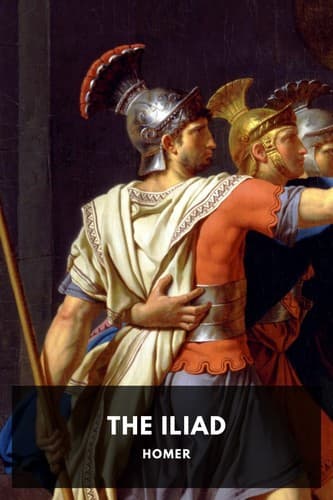
Achilles (Mythological character); Epic poetry, Greek -- Translations into English; Trojan War
Thus having spoken, they clad themselves in their terrible arms. To
Diomede, Thrasymedes, firm in war, gave his two-edged sword, because
his own was left at the ships, and a shield. Upon his head he placed
his bull’s-hide helmet, coneless, crestless, which is called cataityx,
348 and protects the heads of blooming youths. And Meriones gave a bow,
quiver, and sword to Ulysses, and put upon his head a casque of hide;
and within, it was firmly bound with many straps; whilst without, the
white teeth of an ivory-tusked boar set thick together on all sides
fenced it well, and skilfully; and in the midst a woollen head-piece
349 was sewed. It Autolycus once brought from Eleon, the city of
Amyntor, son of Hormenus, having broken into his large mansion. He gave
it, however, to Amphidamas, the Cytherian, to bear to Scandea, and
Amphidamas bestowed it upon Molus, to be a gift of hospitality, but he
gave it to his son Meriones to be worn. Then at last, being placed
around, it covered the head of Ulysses. But they, when they had girt
themselves in dreadful arms, hastened to advance, and left all the
chiefs at the same place. And to them near the way, Pallas Minerva sent
a heron upon the right hand: they did not discern it with their eyes,
because of the gloomy night, but heard it rustling. And Ulysses was
delighted on account of the bird, and prayed to Minerva:
“Hear me, thou daughter of ægis-bearing Jove, who standest by me in all
labours, nor do I escape thy notice, having moved. 350 Now again do
thou, O Minerva, especially befriend me, and grant that, covered with
glory, we may return back to the well-benched barks, having performed a
mighty deed, which will surely occasion care to the Trojans.”
Footnote 348: (return) “The καταῖτυξ might be termed the undress
helmet of the chief who wore it.”—Kennedy.
Footnote 349: (return) Or, “it was stuffed with felt.”—Oxford Transl.
“Wool was inlaid between the straps, in order to protect the head, and
make the helmet fit closer.”—Kennedy.
Footnote 350: (return) Soph. Aj. 18: Καὶ νῦν ἐπέγνως εὖ μ ἐπ’ ἀνδρὶ
δυσμενεῖ Βάσιν ευκλοῦντ’.
Then Diomede, brave in the din of battle, next prayed: “Now hear me,
too, O daughter of Jove, invincible. Attend me, as once thou didst
attend my sire, the noble Tydeus, to Thebes, what time he went as an
ambassador for the Achæans; he left the brazen-mailed Achæans at the
Asopus, and he himself bore thither a mild message to the Cadmæans: but
when returning he performed many arduous deeds, with thy aid, O noble
goddess, when thou propitious didst stand beside him. Thus now
willingly stand by and protect me; and in return I will sacrifice to
thee a heifer of a year old, with broad forehead, untamed, which no man
hath yet brought under the yoke. This will I sacrifice to thee,
encircling its horns with gold.”
Public-domain text, read in full here on John Shaqi.
Reviews
Reviews
No reviews yet
Be the first to share your thoughts on this work.
Elsewhere in the archive
Join the Discussion
Join the discussion
Sign in to leave a comment or review.
Sign InorCreate an account