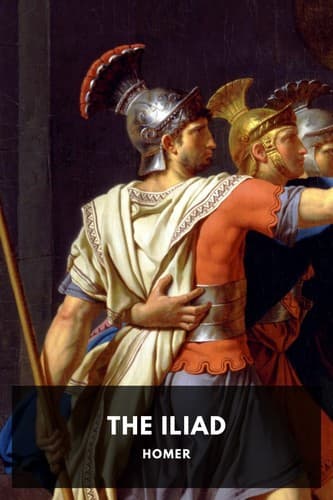
Achilles (Mythological character); Epic poetry, Greek -- Translations into English; Trojan War
But him Telamonian Ajax answering, addressed: “So also to me are my
strong hands upon my spear eager, and my courage is aroused, and I am
hurried along by both my feet under me; and I eagerly long, even alone,
to combat with Hector, the son of Priam, insatiably raging.”
Thus they addressed these words to each other, joyful in the desire of
battle 414 which the god had infused into their minds. In the meanwhile
the Earth-ruler (Neptune) aroused the Achæans in the rear, who were
recruiting their spirit at the swift ships; whose limbs were at the
same time relaxed with toilsome labour, and grief was arising in their
minds, beholding the Trojans, who with a tumult had surmounted the vast
wall. But beholding them, they poured forth tears from beneath their
eyebrows, for they expected not to escape destruction: but the
Earth-shaker intervening, easily aroused the brave phalanxes. To Teucer
and Leius he first came, exhorting them, and to the hero Peneleus, and
Thoas, and Deipyrus, and to Meriones and Antilochus, skilful in war.
These he encouraging, spoke winged words:
Footnote 414: (return) See Heyne, who compares the Latin _gestire_.
Hesych.: Χάρμη, η ρετά χαράς μάχη.
“O shame! Argives, young men, I trust that our ships will be preserved
by your fighting; but if ye be remiss in the destructive battle, the
day is now come [for us] to be subdued by the Trojans. Ye gods, surely
I behold with my eyes a great marvel, terrible, which I never expected
would be brought to pass, that the Trojans should approach our ships;
who formerly, like unto timid stags, which through the wood are the
prey of lynxes, pards, and wolves, foolishly straying about, weak, nor
fit for combat: so the Trojans formerly would not stand even for a
little against the might and prowess of the Greeks. But now, far away
from the city, they combat at the hollow ships, through the
perverseness of our general, and the indifference of the troops; who,
disputing with him, are unwilling to defend the swift ships, but are
slain among them. Yet although in reality the hero, the son of Atreus,
wide-ruling Agamemnon, be altogether in fault, in that he hath
dishonoured the swift-footed son of Peleus, still it is by no means our
duty to be remiss in battle, but let us the sooner repair [the
mischief]; 415 the minds of the brave are easily appeased. But they by
no means honourably remit your impetuous valour, being all the bravest
in the army: I indeed would not quarrel with a man who should desist
from combat, being unwarlike; but with you I am indignant from my
heart. O soft ones! surely will ye soon create some greater evil by
this inertness: but do each of you in his mind ponder on the shame and
reproach; for certainly a mighty contest hath arisen. Now indeed brave
Hector, good in the din of war, combats at the ships, and hath burst
through the gates and the long bar.”
Public-domain text, read in full here on John Shaqi.
Reviews
Reviews
No reviews yet
Be the first to share your thoughts on this work.
Elsewhere in the archive
Join the Discussion
Join the discussion
Sign in to leave a comment or review.
Sign InorCreate an account