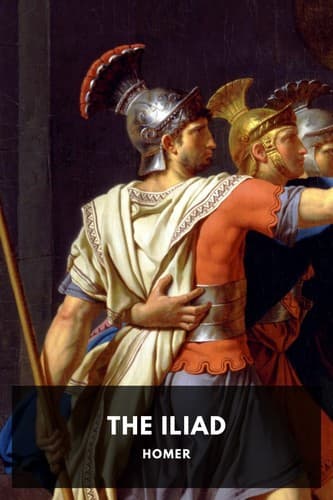
Achilles (Mythological character); Epic poetry, Greek -- Translations into English; Trojan War
Thus he spoke. But Meriones, equal to rapid Mars, began to proceed,
until he came to [that part of] the army whither he had ordered him.
But they, when they beheld Idomeneus, like unto a flame in might, both
him and his attendant, in variously-wrought armour, they all, exhorting
one another along the crowd, advanced against him, and an equal contest
arose at the sterns of their ships. And as when storms sweep along,
[driven] by the shrill winds, on a day when the dust around the roads
[is] very abundant, and they at the same time raise up a large cloud of
dust; so came on the battle of these together, and they were eager in
their minds to slaughter one another throughout the throng with the
sharp brass. And the mortal-destroying combat bristles with the long
spears which they held, flesh-rending; and the brazen splendour from
the gleaming helmets, the newly-burnished corslets, and the shining
shields, coming together, dazzled their eyes. Very brave-hearted would
he be who, when beholding their toil, could have rejoiced, and would
not be disturbed.
But the two powerful sons of Saturn, favouring different sides, planned
grievous toils for the heroes. On the one hand, Jove willed victory to
the Trojans and to Hector, glorifying swift-footed Achilles; yet he
desired not entirely to destroy the Grecian people before Ilium, but
was honouring Thetis and her magnanimous son. On the other hand,
Neptune, coming amongst them, encouraged the Greeks, having secretly
emerged from the hoary deep; for he grieved that they should be subdued
by the Trojans, and he was greatly indignant with Jove. The same race
indeed was to both, and the same lineage, but Jove was born first, 422
and knew more. For this reason [Neptune] avoided aiding them openly,
but always kept privately inciting them through the army, assimilated
to a man. They indeed alternately stretched over both the cord of
vehement contest and equally destructive war, irrefragable and
indissoluble, which relaxed the knees of many. Then, although
half-hoary Idomeneus, encouraging the Greeks, rushing upon the Trojans,
created night; for he slew Othryoneus, who had come from Cabesus,
staying within [Priam’s house]. 423 He had lately come after the rumour
of the war, and demanded Cassandra, the most beautiful in form of the
daughters of Priam, without a dowry; and he had promised a mighty deed,
to repulse in spite of themselves the sons of the Greeks from Troy. But
to him aged Priam had promised her, and pledged himself 424 to give
her; therefore he fought, trusting in these promises. But Idomeneus
took aim at him with his shining spear, and hurling it, struck him,
strutting proudly; nor did the brazen corslet which he wore resist it,
but he fixed it in the middle of his stomach. And falling, he gave a
crash, and [the other] boasted and said:
Public-domain text, read in full here on John Shaqi.
Reviews
Reviews
No reviews yet
Be the first to share your thoughts on this work.
Elsewhere in the archive
Join the Discussion
Join the discussion
Sign in to leave a comment or review.
Sign InorCreate an account