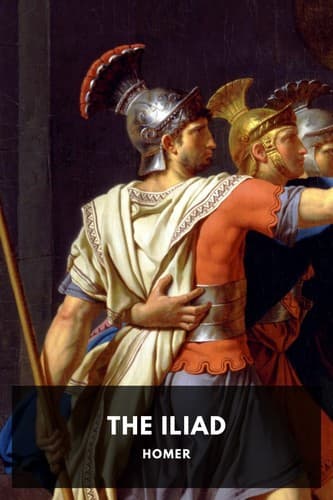
Achilles (Mythological character); Epic poetry, Greek -- Translations into English; Trojan War
Footnote 445: (return) Τέμει refers to ἄροτρον in v. 703, not to
ζυγόν.
Footnote 446: (return) Put for ἀμήχανόν ἐστι πείθειν σε.
Footnote 447: (return) A favourite proverb. Cf. Duport, Gnom. p. 81.
Footnote 448: (return) So “corona,” in Latin.
“Polydamas, do thou retain here all the bravest, whilst I will come
back again immediately after I have given proper orders to the
[troops].” He said, and shouting, he rushed on, like unto a snowy
mountain, and flew through the Trojans and the allies. But they all
crowded round valour-loving Polydamas, the son of Panthous, as soon as
they heard the voice of Hector. He, however, ranged through the
foremost combatants, seeking if he could anywhere find Deïphobus, the
might of king Helenus, and Adamas, the son of Asias, and Asius, the son
of Hyrtacus. Some he found no longer quite unhurt, nor yet destroyed,
whilst others again lay at the sterns of the ships of the Greeks,
having lost their lives by the hands of the Greeks; and others were
stricken or wounded within the wall. But he quickly found noble
Alexander, the husband of fair-haired Helen, on the left of the
lamentable battle, cheering of his companions, and encouraging them to
fight; and, standing near, he addressed him with reproachful words:
“Accursed Paris, fine only in person, woman-mad, seducer, where are
Deïphobus and the might of king Helenus, and Adamas, the son of Asias,
and Asius, the son of Hyrtacus? Where also is Othryoneus? Now lofty
Ilium all perishes from its summit, 449 now is its final destruction
certain.”
Footnote 449: (return) The Latin “a culmine,” as in Virg. Æn. ii. 290,
603. So Æsch.
But him godlike Alexander in turn addressed: “Hector, since it is thy
intention to find fault with me when innocent, at some other time
perhaps, I may be more neglectful of the fight; [but not now], since
neither did my mother bear me altogether unwarlike. For from the time
when thou didst stir up the battle of thy companions at the ships, from
that time, remaining here, have we engaged incessantly with the Greeks;
and those comrades are dead for whom thou inquirest. Deïphobus and the
might of king Helenus alone have withdrawn, both wounded in the hand
with long spears; but the son of Saturn hath warded off death [from
them]. But now lead on, wheresoever thy heart and soul urge thee; and
we will follow with determined minds, nor do I think that thou wilt be
at all in want of valour, as much strength as is in us. It is not
possible even for one, although keenly desirous, to fight beyond his
strength.”
Public-domain text, read in full here on John Shaqi.
Reviews
Reviews
No reviews yet
Be the first to share your thoughts on this work.
Elsewhere in the archive
Join the Discussion
Join the discussion
Sign in to leave a comment or review.
Sign InorCreate an account