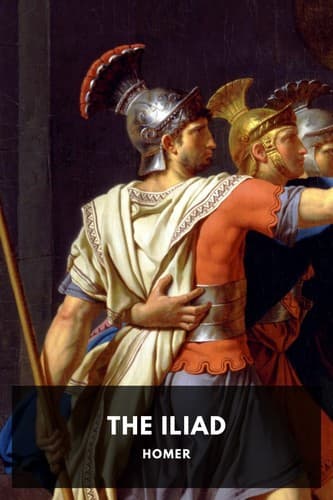
Achilles (Mythological character); Epic poetry, Greek -- Translations into English; Trojan War
For this did provident Jove await, till he should behold with his eyes
the flame of a burning vessel; for from that time he was about to make
a retreat of the Trojans from the ships, and to afford glory to the
Greeks. Designing these things, he aroused Hector, the son of Priam,
against the hollow ships, although himself very eager. But he raged, as
when Mars [rages], brandishing his spear, or [when] a destructive fire
rages in the mountains, in the thickets of a deep wood. And foam arose
about his mouth, and his eyes flashed from beneath his grim eyebrows;
and the helm was shaken awfully upon the temples of Hector, fighting;
for Jove himself from the æther was an assistant to him, and honoured
and glorified him alone amongst many men; because he was destined to be
short-lived: for Pallas Minerva already impelled him towards the fatal
day, by the might of the son of Peleus. And he wished to break the
ranks of heroes, trying them, wheresoever he beheld the greatest crowd
and the best arms. But not thus was he able to break through them,
although very eager; for they, compact in squares, sustained his
attack, as a lofty, huge cliff, being near the hoary deep, which abides
the impetuous inroads of the shrill winds, and the swollen billows
which are dashed against it. Thus the Greeks firmly awaited the
Trojans, nor fled. But he, gleaming with fire on all sides, rushed upon
the crowd; and fell upon them, as when an impetuous wave, wind-nurtured
from the clouds, dashes against a swift ship, and it [the ship] is
wholly enveloped with the spray, and a dreadful blast of wind roars
within the sail: but the sailors tremble in mind, fearing, because they
are borne but a little way from death: thus was the mind of the Greeks
divided in their breasts. He, however, like a destructive lion coming
upon oxen which feed in myriads in the moist ground of a spacious
marsh, and amongst them a keeper not very skilful in fighting with a
wild beast for the slaughter of a crooked-horned ox; 500 he indeed
always accompanies the foremost or the hindmost cattle, whilst [the
lion] springing into the midst, devours an ox, and all the rest fly in
terror; thus then were the Greeks wondrously put to flight by Hector
and father Jove, all—but [Hector] slew only Mycenæan Periphetes, the
dear son of Copreus, who went with a messenger of king Eurystheus to
mighty Hercules. From this far inferior father sprung a son superior in
all kinds of accomplishments, as well in the race as in the combat, and
who in prudence was among the first of the Mycenæans, who at that time
gave into the hands of Hector superior glory. For, turning backwards,
he trod upon the rim of his shield which he bore, a fence against
javelins, which reached to his feet; by this incommoded, he fell upon
his back, and the helmet terribly sounded round the temples of him
fallen. But Hector quickly perceived, and running, stood near him, and
fixed his spear in his breast, and slew him near his beloved
Public-domain text, read in full here on John Shaqi.
Reviews
Reviews
No reviews yet
Be the first to share your thoughts on this work.
Elsewhere in the archive
Join the Discussion
Join the discussion
Sign in to leave a comment or review.
Sign InorCreate an account