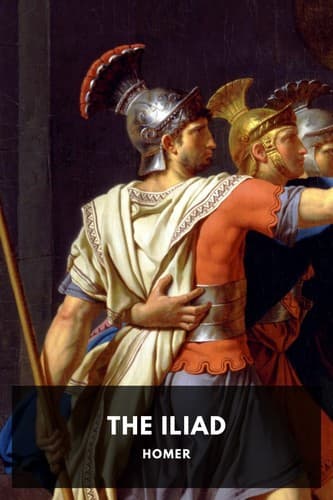
Achilles (Mythological character); Epic poetry, Greek -- Translations into English; Trojan War
“O my friends, Grecian heroes, servants of Mars, be men, my friends,
and be mindful of impetuous strength. Whether do we think that we have
any assistants in the rear, or any stronger rampart which may avert
destruction from the men? Indeed there is not any other city near,
fortified with towers, where we may be defended, having a reinforcing
army; but bordering on the sea, we sit in the plain of the well-armed
Trojans, far away from our native land; therefore safety is in our
exertions, not in remission of battle.”
He said, and furious, charged with his sharp spear whoever of the
Trojans was borne towards the hollow ships with burning fire, for the
sake of Hector who incited them;—him Ajax wounded, receiving him with
his long spear; and he slew twelve in close fight before the ships.
Footnote 504: (return) The reader will do well to read the beautiful
sketch of this hero’s deification after death in Philostratus’s preface
to the Heroica. He was the first of the Greeks who fell, being slain by
Hector as he leaped from the vessel (Hygin. Fab. ciii.; Auson. Epigr.
xx.). He was buried on the Chersonese, near the city Plagusa. Hygin.
P.A. ii. 40.
Footnote 505: (return) The Oxford translator renders ἄφλαστον “the
tafferel.”
Footnote 506: (return) This is, I think, much more spirited than the
Scholiast’s πάντων πόνων ἰσόῤῥοπον, or πάντων τῶν τολμηθέντων. Supply,
therefore, ήμάτων.
Footnote 507: (return) _I.e._ befooled our senses, taking away our
proper spirit. So Theognισ has υοοῖ βεβλαμμένος ἐσθλοῦ.
BOOK THE SIXTEENTH.
ARGUMENT.
Patroclus at length obtains permission from Achilles, and enters the
fight, on condition that he should return after liberating the Greeks
from their immediate peril. He comes opportunely to the assistance of
Ajax, routs the Trojans, and kills Sarpedon, whose body, but without
the armour, is rescued by Hector and Glaucus. Forgetful of his promise
to Achilles, Patroclus pursues the Trojans to their very walls. He is
driven back by Apollo, but slays the charioteer of Hector, Cebriones.
He is suddenly afflicted with stupor by Apollo, and dies by the hand of
Hector, whose death he foretells. Hector pursues Automedon with the
chariot of Achilles towards the ships.
Thus, then, they were fighting for the well-benched ship. But Patroclus
stood beside Achilles, the shepherd of the people, shedding warm 508
tears; as a black-water fountain, which pours its sable tide down from
a lofty rock. But swift-footed noble Achilles, seeing, pitied him, and
addressing him, spoke winged words:
Public-domain text, read in full here on John Shaqi.
Reviews
Reviews
No reviews yet
Be the first to share your thoughts on this work.
Elsewhere in the archive
Join the Discussion
Join the discussion
Sign in to leave a comment or review.
Sign InorCreate an account