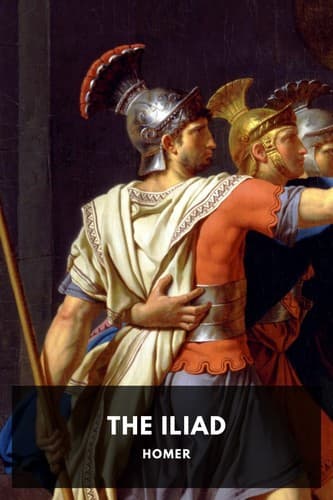
Achilles (Mythological character); Epic poetry, Greek -- Translations into English; Trojan War
shield, which reached to his heels, with its belt, fell to the ground;
and king Apollo, the son of Jove, unbound his corslet. But stupor
seized his brain, and his fair limbs were relaxed under him, and he
stood astounded. But a Trojan, hero, Euphorbus, the son of Panthous,
who excelled those of his own age in the spear, in horsemanship, and in
swiftness of foot, smote him close at hand with his sharp spear, in the
back between the shoulders. For even before this he had hurled twenty
men from their horses, at first coming with his chariot, learning [the
art] of war. He [it was] who first hurled a weapon at thee, O knight
Patroclus, nor did he subdue thee; for he ran back, and was mingled
with the crowd, having plucked the ashen spear out of thy body; nor did
he await Patroclus, though being unarmed, in the fight. Patroclus,
however, subdued by the blow of the god, and by the spear, retired into
the crowd of his companions, avoiding death. But Hector, when he
perceived magnanimous Patroclus retiring, wounded with a sharp spear,
went through the ranks near him, and smote him with his javelin in the
lowest part of the groin, and drove the brass quite through. Falling,
he gave a crash, and greatly grieved the people of the Greeks. As when
a lion presses on an unwearied boar in fight, and they twain, high
spirited, contend upon the mountain tops for a small rill, for they
both desire to drink, but the lion subdues him by force, panting much;
so Hector, the son of Priam, in close fight with his spear, deprived
the gallant son of Menœtius of life, having slain many; and, boasting
over him, spoke winged words:
Footnote 544: (return) Swam round, probably from exhaustion. Celsus;
i. 3: “Si quando insuetus aliquis laboravit, aut si multo plus, quam
solet, etiam is qui assuevit...... oculi caligant.” The affection is
well described by Cælius Aurol. Chron. i. 2: “Repentina visus
tenebratio, atque nebula, cum capitis vertigine.”
“Patroclus, doubtless thou didst think to waste our city, and to carry
off in thy ships the Trojan women to thy dear father-land, having taken
away their day of freedom,—infatuated one! But in defence of these, the
fleet steeds of Hector hasten with their feet to war, and I myself, who
avert the day of slavery 545 from them, am conspicuous amongst the
war-loving Trojans in [the use of] the spear. But the vultures shall
devour thee here. Unhappy man! Nor indeed did Achilles, although being
brave, aid thee, who remaining behind, doubtless enjoined many things
to thee, going forth: ‘Do not return to me, O equestrian Patroclus, to
the hollow barks, before thou rendest the blood-stained garment around
the breast of man-slaughtering Hector.’ Thus, doubtless, he addressed
thee, and persuaded the mind of foolish thee.”
Public-domain text, read in full here on John Shaqi.
Reviews
Reviews
No reviews yet
Be the first to share your thoughts on this work.
Elsewhere in the archive
Join the Discussion
Join the discussion
Sign in to leave a comment or review.
Sign InorCreate an account