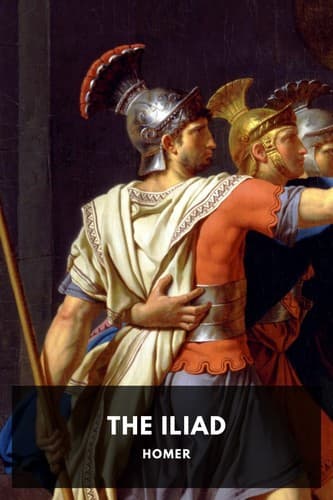
Achilles (Mythological character); Epic poetry, Greek -- Translations into English; Trojan War
But him sternly regarding, crest-tossing Hector addressed: “O Glaucus,
why hast thou, being such as thou art, spoken haughtily? I’ faith,
friend, I thought that thou didst excel in judgment the others, as many
as inhabit fertile Lycia; but now I altogether blame thy understanding,
since thou hast thus spoken, thou who sayest that I do not withstand
mighty Ajax. Neither have I dreaded the battle, nor the tumult of
steeds; but the counsel of ægis-bearing Jove is ever superior, who puts
even the valiant man to flight, and easily takes away the victory; but
at another time he himself impels him to fight. But come hither, my
friend, stand by me, and behold my conduct. Truly I shall always be a
coward, as thou sayest, or I will restrain even some of the Greeks,
although very eager, from keeping defence over dead Patroclus.”
Thus saying, he cheered on the Trojans, loudly shouting, “Ye Trojans
and Lycians, and close-fighting Dardanians, be men, my friends, and be
mindful of impetuous valour, whilst I put on the armour of illustrious
Achilles, beautiful, of which I despoiled mighty Patroclus, having
slain him.”
Thus having spoken, crest-tossing Hector departed from the glowing
battle, and, running very quickly, overtook his companions, not far
off, following with swift feet those who were bearing towards the city
the renowned arms of Achilles. Then standing apart from the mournful
battle, he changed his armour. His own indeed he gave to the warlike
Trojans to bear to sacred Ilium; but he put on the immortal arms of
Achilles, the son of Peleus, which the heavenly gods had bestowed on
his dear father; but he indeed, growing old, presented them to his son;
but the son grew not old in the armour of his father.
But when cloud-compelling Jove beheld him apart, accoutred in the
armour of divine Pelides, then shaking his head, he said to his own
soul:
“Ah! luckless one; nor is death at all in thy thoughts, which is now
near thee; but thou puttest on the immortal armour of the bravest hero,
at whom others also tremble; and thou hast slain his companion, both
gentle and brave, and thou hast taken the armour from his head and
shoulders not according to propriety. But now will I give into thy
hands a great victory, a compensation for this, that Andromache shall
never receive from thee, having returned from the battle, the
illustrious arms of the son of Peleus.”
The son of Saturn spoke, and moreover nodded with his sable brows. But
the armour fitted the person of Hector, and Mars, the dreadful warrior,
entered him. And his limbs were inwardly filled with might and
strength, and he went after the illustrious allies, exclaiming aloud;
and glittering in his armour, to all of them he presented the
appearance of the magnanimous son of Peleus. But going among them, he
animated each with his words,—Mesthles, Glaucus, Medon, and
Thersilochus, Asteropæus, Disenor, and Hippothoüs, Phorcys, Chromius,
and Ennomus the augur. Exhorting these, he spoke winged words:
Public-domain text, read in full here on John Shaqi.
Reviews
Reviews
No reviews yet
Be the first to share your thoughts on this work.
Elsewhere in the archive
Join the Discussion
Join the discussion
Sign in to leave a comment or review.
Sign InorCreate an account