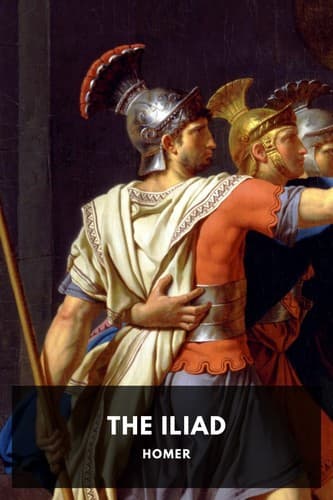
Achilles (Mythological character); Epic poetry, Greek -- Translations into English; Trojan War
Thus then having spoken, yellow-haired Menelaus departed, gazing round
in all directions, like an eagle, which, they say, sees most acutely of
birds beneath the sky, and which, though being aloft, the swift-footed
hare does not escape, when lying beneath the dense-foliaged thicket;
but he pounces upon it, and quickly seizing it, deprives it of life.
Thus, O Jove-nurtured Menelaus, were thy shining eyes turned round in
all directions through the band of thy numerous companions, if anywhere
thou mightst behold the son of Nestor, yet living. But him he very soon
perceived upon the left of all the battle, encouraging his companions,
and inciting them to fight; and standing near, yellow-haired Menelaus
addressed [him]:
“Ho! hither come, Antilochus, Jove-nurtured, that thou mayest hear the
sad message which—would that it had not happened. I think, indeed, that
thou thyself looking, perceivest that a god rolls disaster upon the
Greeks, but that victory is on the side of the Trojans; for Patroclus,
the bravest of the Greeks, is slain; and a great longing [after him]
has befallen the Greeks. But do thou quickly tell it to Achilles,
running to the ships of the Greeks, if perchance quickly he may bring
in safety to his ships the unarmed body; for crest-tossing Hector
possesses the armour.”
Thus he spoke; but Antilochus shuddered, hearing the news; and long did
a want of words possess him; and his eyes were filled with tears, and
his liquid voice was interrupted. Yet not even thus did he neglect the
command of Menelaus; but he hastened to run, and gave his armour to
Laodocus, his blameless companion, who, near him, managed the
solid-hoofed steeds. Him, however, his feet bore, weeping, from the
battle, about to communicate the evil news to Achilles, son of Peleus.
Nor, O Jove-nurtured Menelaus, was thy mind willing to aid the harassed
comrades, in the place whence Antilochus had departed, and great
longing after him was caused to the Pylians; but to them he sent noble
Thrasymedes, and he himself went again towards the hero Patroclus; but
arriving, he stood beside the Ajaces, and immediately addressed them:
“Him, indeed, I have now despatched to the swift ships, to go to
swift-footed Achilles: yet I do not think that he will come, although
greatly enraged with noble Hector; for being unarmed, he could by no
means fight with the Trojans. Let even us then ourselves deliberate
upon the best plan, as well how we shall draw off the body, as also how
we ourselves may escape Death and Fate from the clamour of the
Trojans.”
But him mighty Telamonian Ajax then answered:
“All things correctly hast thou spoken, O illustrious Menelaus. But do
thou, and Meriones, stooping quickly under it, having lifted it up,
bear the body from the fight; whilst we two of like name, possessing
equal courage, will fight with the Trojans and with noble Hector, we
who even formerly have sustained the sharp conflict, remaining by each
other.”
Public-domain text, read in full here on John Shaqi.
Reviews
Reviews
No reviews yet
Be the first to share your thoughts on this work.
Elsewhere in the archive
Join the Discussion
Join the discussion
Sign in to leave a comment or review.
Sign InorCreate an account