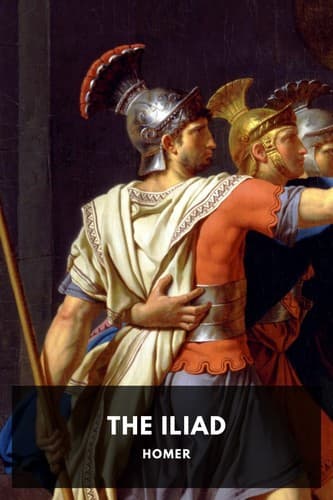
Achilles (Mythological character); Epic poetry, Greek -- Translations into English; Trojan War
Thus they on their part laboured in the violent fight. But you would
not have known the son of Tydeus, to which side he belonged, whether he
was mixed with the Trojans or with the Greeks. For he rushed through
the plain, like unto a river swollen by mountain-streams, which flowing
rapidly throws down bridges: and this, neither the fortified dams can
restrain, nor the fences of the richly-blooming fields check, as it
comes suddenly, when the rain-storm of Jove bears down heavily: many
hopeful works of vigorous youths are wont to fall by it. Thus by the
son of Tydeus were the close phalanxes of the Trojans thrown into
confusion; nor did they withstand him, although being numerous.
When, therefore, Pandarus, the illustrious son of Lycaon, saw him
rushing through the field, discomfiting the phalanxes before him, he
drew his crooked bow, and smote him rushing on, striking him upon the
right shoulder [on] the cavity of the corslet: the bitter shaft flew on
and broke through to the other side; and the corslet was stained with
blood. Whereupon the illustrious son of Lycaon exclaimed aloud:
“Rush on, ye magnanimous Trojans, spurrers of steeds, for the bravest
of the Greeks is wounded; nor do I think that he will long endure the
violent arrow, if king Apollo, the son of Jove, really urged me
proceeding from Lycia.”
Thus he spoke, vaunting; but him [Diomede] the swift arrow did not
subdue: but having retreated, he stood before his horses and chariot,
and thus accosted Sthenelus, son of Capaneus:
“Haste, dear son of Capaneus, descend from thy chariot, that thou
mayest draw from my shoulder the bitter shaft.”
Thus he spoke, and Sthenelus leaped from his chariot to the ground,
and, standing by him, drew the swift, deeply-piercing arrow forth from
his shoulder, and the blood spurted out through the twisted mail. Then
Diomede, brave in battle, prayed:
“Hear me, O daughter of aegis-bearing Jove, unwearied, if ever
favouring thou stoodest by me and my sire in the hostile fight, now in
turn befriend me, O Minerva. And grant me to slay this man, and that he
may approach within the aim of my spear, who being beforehand has
struck me, and boasts, and says that I shall not long behold the
brilliant light of the sun.”
Thus he spoke, praying, and Pallas Minerva heard him, and made light
his limbs, his feet, and his hands above, and standing near him, spoke
winged words:
“With confidence, now, O Diomede, fight against the Trojans; for into
thy soul have I sent that intrepid ancestral might, such as the
shield-brandishing knight Tydeus was wont to possess: and moreover I
have taken away the darkness from thine eyes, which before was upon
them, that thou mayest discern a god and also a man. Wherefore now, if
any divinity come hither, making trial of thee, do thou by no means
fight against any other immortal gods; but if Venus, daughter of Jove,
should come into battle, wound her at all events with the sharp brass.”
Public-domain text, read in full here on John Shaqi.
Reviews
Reviews
No reviews yet
Be the first to share your thoughts on this work.
Elsewhere in the archive
Join the Discussion
Join the discussion
Sign in to leave a comment or review.
Sign InorCreate an account