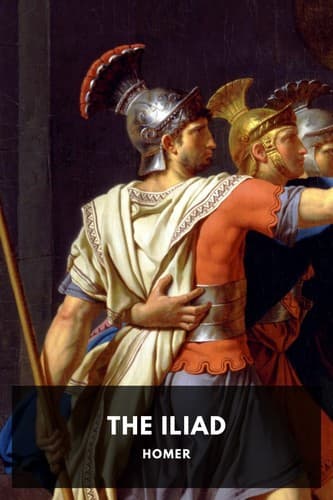
Achilles (Mythological character); Epic poetry, Greek -- Translations into English; Trojan War
Thus having spoken, he hurled forth [his lance], and Minerva directed
the weapon to his nose, near the eye; and it passed quite through his
white teeth: and then unwearied, the brass cut the root of his tongue,
and the point came out at the bottom of his chin. From his chariot he
fell, and his variegated, shining 210 arms resounded upon him; but his
swift-footed steeds started aside through fright, and there were his
soul and strength dissolved. Æneas then bounded down with his shield
and long spear, fearing lest the Greeks by any means should take the
body away from him. He walked round it, therefore, like a lion,
confiding in his strength: and before him he stretched out his lance,
and his shield equal on all sides, shouting dreadfully, eager to slay
him, whoever might come against him. But the son of Tydeus seized in
his grasp a hand-stone, a huge affair, such as no two men could carry,
such at least as mortals are now; but he even alone easily wielded it.
With it he struck Æneas on the hip, where the thigh is turned in the
hip;—they call it the socket;—the socket he smote violently, and broke
besides both tendons, and the rugged stone tore off the skin. But the
hero having fallen on his knees, remained so, and supported himself
with his strong hand upon the ground, and dark night veiled his eyes.
Footnote 210: (return) But Buttm. Lexil. p. 65 prefers “agile,” _i.
e._ easily-wielded.
And there, of a truth, Æneas, the king of men, had perished, unless
Venus, the daughter of Jove, had quickly perceived him, his mother, who
brought him forth to Anchises as he fed his oxen; 211 but around her
own dear son she spread her white arms, and before him she extended the
folds of her shining robe, as a fence against arrows, lest any of the
swift-horsed Greeks having cast the steel into his breast, should take
away his life. She, indeed, stealthily bore off her beloved son from
the battle. Nor was the son of Capaneus forgetful of those commands
which warlike Diomede gave him: but he detained his own solid-hoofed
steeds apart from the tumult, having stretched forth the reins from the
rim; and rushing forward, drove from the Trojans to the well-greaved
Greeks the beautiful-maned steeds of Æneas, and gave them to Deipylus,
his beloved companion (whom he honoured above all his coevals, because
he possessed in his mind sentiments congenial with himself), to drive
them to the hollow ships: but the hero himself, having ascended his
chariot, took the splendid reins; and instantly drove his solid-hoofed
steeds after the son of Tydeus with ardour; but Diomede pursued Venus
with the cruel steel, 212 knowing that she was an unwarlike goddess,
nor [one] of those goddesses who administer the war of men, neither
Minerva, nor city-destroying Bellona. But when he had now overtaken
her, having pursued her through a great crowd, then the son of
magnanimous Tydeus, having stretched forward, wounded the feeble
Public-domain text, read in full here on John Shaqi.
Reviews
Reviews
No reviews yet
Be the first to share your thoughts on this work.
Elsewhere in the archive
Join the Discussion
Join the discussion
Sign in to leave a comment or review.
Sign InorCreate an account