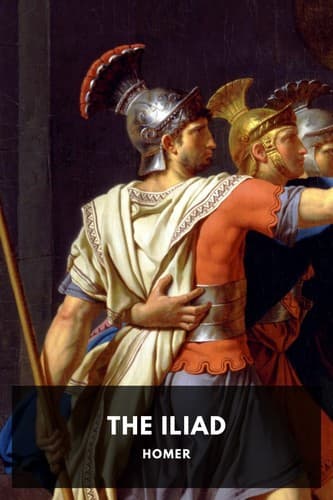
Achilles (Mythological character); Epic poetry, Greek -- Translations into English; Trojan War
“Who of mortal men art thou, O most brave? For never yet have I beheld
thee in the glorious fight: but now indeed thou hast far surpassed all
in thy confidence, since thou hast awaited my long-shadowed spear.
Certainly they are sons of the hapless who meet my strength. But, if
one of the immortals, thou art come from heaven, I would not fight with
the celestial gods. For valiant Lycurgus, the son of Dryas, did not
live long, who contended with the heavenly gods; he who once pursued
the nurses of raving Bacchus through sacred Nyssa; but they all at once
cast their sacred implements 240 on the ground, smitten by man-slaying
Lycurgus with an ox-goad; but Bacchus, too, terrified, sunk under the
wave of the sea, and Thetis received him affrighted in her bosom; for
dreadful trembling had seized him, on account of the threat of the man.
With him the peaceful-living gods were afterwards enraged, and the son
of Saturn rendered him blind, nor did he live much longer, for he
became an object of aversion to all the immortal gods. Wherefore I
should not wish to fight with the blessed gods. But if thou art any one
of mortals, who eat the fruit of the earth, come hither, that thou
mayest speedily reach the goal of death.”
Footnote 240: (return) Not merely the thyrsi. See Anthon.
Him then the renowned son of Hippolochus addressed in turn:
“Magnanimous son of Tydeus, why dost thou inquire of my race? As is the
race of leaves, even such is the race of men. 241 Some leaves the wind
sheds upon the ground, but the fructifying wood produces others, and
these grow up in the season of spring. Such is the generation of men;
one produces, another ceases [to do so]. But if thou wouldst learn even
these things, that thou mayest well know my lineage (for many know it),
there is a city, Ephyra, in a nook of horse-pasturing Argos; there
dwelt Sisyphus, who was the most cunning of mortals, Sisyphus, son of
Æolus; and he begat a son, Glaucus. But Glaucus begat blameless
Bellerophon; to whom the gods gave beauty and agreeable manliness. But
against him Prœtus devised evils in his soul: who accordingly banished
him from the state (since he was far the best of the Greeks; for Jove
had subjected them to his sceptre). With him the wife of Prœtus, noble
Antea, 242 passionately longed to be united in secret love; but by no
means could she persuade just-minded, wise-reflecting Bellerophon. She,
therefore, telling a falsehood, thus addressed king Prœtus: ‘Mayest
thou be dead, O Prœtus! or do thou slay Bellerophon, who desired to be
united in love with me against my will.’ Thus she said: but rage
possessed the king at what he heard. He was unwilling, indeed, to slay
him, for he scrupled this in his mind; but he sent him into Lycia, and
gave to him fatal characters, writing many things of deadly purport on
a sealed tablet; and ordered him to show it to his father-in-law, to
the end that he might perish. He therefore went into Lycia, under the
Public-domain text, read in full here on John Shaqi.
Reviews
Reviews
No reviews yet
Be the first to share your thoughts on this work.
Elsewhere in the archive
Join the Discussion
Join the discussion
Sign in to leave a comment or review.
Sign InorCreate an account