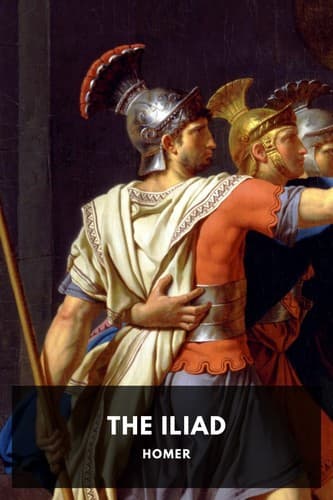
Achilles (Mythological character); Epic poetry, Greek -- Translations into English; Trojan War
So spake he, but much-enduring noble Odysseus heard him not, but
hastened by to the hollow ships of the Achaians. Yet Tydeides, though
but one, mingled amid the fighters in the forefront, and took his stand
before the steeds of the old man, Neleus’ son, and spake to him winged
words, and said: “Old man, of a truth young warriors beset thee hard;
and thy force is abated, and old age is sore upon thee, and thy squire
is but a weakling, and thy steeds are slow. Come then, mount upon my
car, that thou mayest see of what sort are the steeds of Tros, well
skilled for following or fleeing hither or thither very fleetly across
the plain, even those that erst I took from Aineias inspirer of fear.*
Thine let our squires tend, and these let us guide straight against the
horse-taming Trojans, that even Hector may know whether my spear also
rageth in my hands.”
* Reading μήστωρα. See Book V. 272.
So said he, and knightly Nestor of Gerenia disregarded not. Then the
two squires tended Nestor’s horses, even Sthenelos the valiant and
kindly Eurymedon: and the other twain both mounted upon Diomedes’ car.
And Nestor took into his hands the shining reins, and lashed the
horses; and soon they drew nigh Hector. Then Tydeus’ son hurled at him
as he charged straight upon them: him missed he, but his squire that
drave his chariot, Eniopeus, high-hearted Thebaios’ son, even him as he
held the reins, he smote upon the breast beside the nipple. So he fell
from out the car, and his fleet-footed horses swerved aside; and there
his soul and spirit were unstrung. Then sore grief encompassed Hector’s
soul for sake of his charioteer. Yet left he him there lying, though he
sorrowed for his comrade, and drave in quest of a bold charioteer; and
his horses lacked not long a master, for anon he found Iphitos’ son,
bold Archeptolemos, and him he made mount behind his fleet horses, and
gave the reins into his hands.
Then had destruction come and deeds beyond remedy been wrought, and so
had they been penned in Ilios like lambs, had not the father of gods
and men been swift to mark. So he thundered terribly and darted his
white lightning and hurled it before Diomedes’ steeds to earth; and
there arose a terrible flame of sulphur burning, and the two horses
were affrighted and cowered beneath the car. And the shining reins
dropped from Nestor’s hands, and he was afraid at heart and spake to
Diomedes: “Come now Tydeides, turn back thy whole-hooved horses to
flight: seest thou not that victory from Zeus attendeth not on thee?
Now doth Kronos’ son vouchsafe glory to this Hector, for the day;
hereafter shall he grant it us likewise, if he will. A man may not at
all ward off the will of Zeus, not though one be very valiant; he
verily is mightier far.”
Public-domain text, read in full here on John Shaqi.
Reviews
Reviews
No reviews yet
Be the first to share your thoughts on this work.
Elsewhere in the archive
Join the Discussion
Join the discussion
Sign in to leave a comment or review.
Sign InorCreate an account