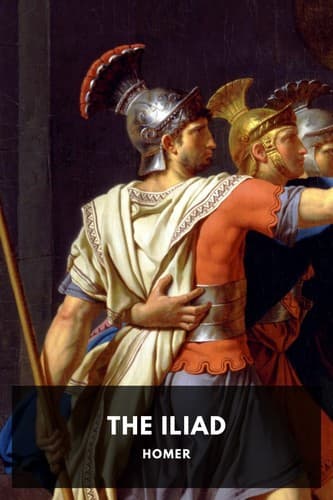
Achilles (Mythological character); Epic poetry, Greek -- Translations into English; Trojan War
So these twain shouted in the front, and aroused the battle of the
Achaians. But as flakes of snow fall thick on a winter day, when Zeus
the Counsellor hath begun to snow, showing forth these arrows of his to
men, and he hath lulled the winds, and he snoweth continually, till he
hath covered the crests of the high hills, and the uttermost headlands,
and the grassy plains, and rich tillage of men; and the snow is
scattered over the havens and shores of the grey sea, and only the wave
as it rolleth in keeps off the snow, but all other things are swathed
over, when the shower of Zeus cometh heavily, so from both sides their
stones flew thick, some towards the Trojans, and some from the Trojans
against the Achaians, while both sides were smitten, and over all the
wall the din arose.
Yet never would the Trojans, then, and renowned Hector have broken the
gates of the wall, and the long bar, if Zeus the Counsellor had not
roused his son Sarpedon against the Argives, like a lion against the
kine of crooked horn. Straightway he held forth his fair round shield,
of hammered bronze, that the bronze-smith had hammered out, and within
had stitched many bulls’ hides with rivets of gold, all round the
circle, this held he forth, and shook two spears; and sped on his way,
like a mountain-nurtured lion, that long lacketh meat, and his brave
spirit urgeth him to make assail on the sheep, and come even against a
well-builded homestead. Nay, even if he find herdsmen thereby, guarding
the sheep with hounds and spears, yet hath he no mind to be driven
without an effort from the steading, but he either leapeth on a sheep,
and seizeth it, or himself is smitten in the foremost place with a dart
from a strong hand. So did his heart then urge on the godlike Sarpedon
to rush against the wall, and break through the battlements. And
instantly he spake to Glaukos, son of Hippolochos: “Glaukos, wherefore
have we twain the chiefest honour,—seats of honour, and messes, and
full cups in Lykia, and all men look on us as gods? And wherefore hold
we a great demesne by the banks of Xanthos, a fair demesne of
orchard-land, and wheat-bearing tilth? Therefore now it behoveth us to
take our stand in the first rank of the Lykians, and encounter fiery
battle, that certain of the well-corsleted Lykians may say, ‘Verily our
kings that rule Lykia be no inglorious men, they that eat fat sheep,
and drink the choice wine honey-sweet: nay, but they are also of
excellent might, for they war in the foremost ranks of the Lykians.’
Ah, friend, if once escaped from this battle we were for ever to be
ageless and immortal, neither would I fight myself in the foremost
ranks, nor would I send thee into the war that giveth men renown, but
now—for assuredly ten thousand fates of death do every way beset us,
and these no mortal may escape nor avoid—now let us go forward, whether
we shall give glory to other men, or others to us.”
Public-domain text, read in full here on John Shaqi.
Reviews
Reviews
No reviews yet
Be the first to share your thoughts on this work.
Elsewhere in the archive
Join the Discussion
Join the discussion
Sign in to leave a comment or review.
Sign InorCreate an account