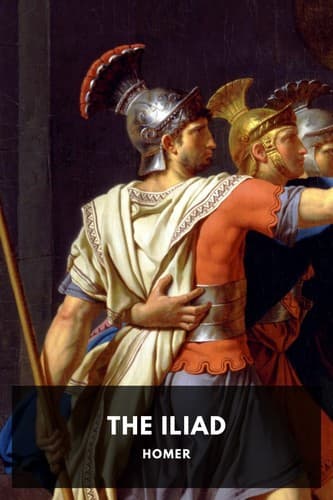
Achilles (Mythological character); Epic poetry, Greek -- Translations into English; Trojan War
Then Thetis the silver-footed goddess answered him, saying: “Yea
verily, my child, no blame is in this, that thou ward sheer destruction
from thy comrades in their distress. But thy fair glittering armour of
bronze is held among the Trojans. Hector of the glancing helm beareth
it on his shoulders in triumph, yet not for long, I ween, shall he
glory therein, for death is hard anigh him. But thou, go not yet down
into the mellay of war until thou see me with thine eyes come hither.
In the morning will I return, at the coming up of the sun, bearing fair
armour from the king Hephaistos.”
Thus spake she and turned to go from her son, and as she turned she
spake among her sisters of the sea: “Ye now go down within the wide
bosom of the deep, to visit the Ancient One of the Sea and our father’s
house, and tell him all. I am going to high Olympus to Hephaistos of
noble skill, if haply he will give unto my son noble armour shining
gloriously.”
Thus spake she, and they forthwith went down beneath the surge of the
sea. And the silver-footed goddess Thetis went on to Olympus that she
might bring noble armour to her son.
So her unto Olympus her feet bore. But the Achaians with terrible cries
were fleeing before man-slaying Hector till they came to the ships and
to the Hellespont. Nor might the well-greaved Achaians drag the corpse
of Patroklos Achilles’ squire out of the darts, for now again overtook
him the host and the horses of Troy, and Hector son of Priam, in might
as it were a flame of fire. Thrice did glorious Hector seize him from
behind by the feet, resolved to drag him away, and mightily called upon
the men of Troy. Thrice did the two Aiantes, clothed on with impetuous
might, beat him off from the dead man, but he nathless, trusting in his
might, anon would charge into the press, anon would stand and cry
aloud, but he gave ground never a whit. As when shepherds in the field
avail nowise to chase a fiery lion in fierce hunger away from a
carcase, so availed not the two warrior Aiantes to scare Hector son of
Priam from the dead. And now would he have won the body and gained
renown unspeakable, had not fleet wind-footed Iris come speeding from
Olympus with a message to the son of Peleus to array him, unknown of
Zeus and the other gods, for Hera sent her. And she stood anigh and
spake to him winged words: “Rouse thee, son of Peleus, of all men most
redoubtable! Succour Patroklos, for whose body is terrible battle afoot
before the ships. There slay they one another, these guarding the dead
corpse, while the men of Troy are fierce to hale him unto windy Ilios,
and chiefliest noble Hector is fain to drag him, and his heart biddeth
him fix the head on the stakes of the wall when he hath sundered it
from the tender neck. But arise, lie thus no longer! let awe enter thy
heart to forbid that Patroklos become the sport of dogs of Troy. Thine
were the shame if he go down mangled amid the dead.”
Public-domain text, read in full here on John Shaqi.
Reviews
Reviews
No reviews yet
Be the first to share your thoughts on this work.
Elsewhere in the archive
Join the Discussion
Join the discussion
Sign in to leave a comment or review.
Sign InorCreate an account