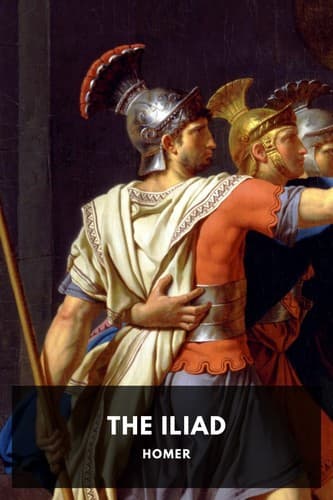
Achilles (Mythological character) -- Poetry; Classical literature; Epic poetry, Greek -- Translations into English; Trojan War -- Poetry
The troops exulting sat in order round,
And beaming fires illumined all the ground.
As when the moon, refulgent lamp of night,[198]
O’er heaven’s pure azure spreads her sacred light,
When not a breath disturbs the deep serene,
And not a cloud o’ercasts the solemn scene,
Around her throne the vivid planets roll,
And stars unnumber’d gild the glowing pole,
O’er the dark trees a yellower verdure shed,
And tip with silver every mountain’s head:
Then shine the vales, the rocks in prospect rise,
A flood of glory bursts from all the skies:
The conscious swains, rejoicing in the sight,
Eye the blue vault, and bless the useful light.
So many flames before proud Ilion blaze,
And lighten glimmering Xanthus with their rays.
The long reflections of the distant fires
Gleam on the walls, and tremble on the spires.
A thousand piles the dusky horrors gild,
And shoot a shady lustre o’er the field.
Full fifty guards each flaming pile attend,
Whose umber’d arms, by fits, thick flashes send,
Loud neigh the coursers o’er their heaps of corn,
And ardent warriors wait the rising morn.
[Illustration: ] THE SHIELD OF ACHILLES
BOOK IX.
ARGUMENT.
THE EMBASSY TO ACHILLES.
Agamemnon, after the last day’s defeat, proposes to the Greeks to quit
the siege, and return to their country. Diomed opposes this, and Nestor
seconds him, praising his wisdom and resolution. He orders the guard to
be strengthened, and a council summoned to deliberate what measures are
to be followed in this emergency. Agamemnon pursues this advice, and
Nestor further prevails upon him to send ambassadors to Achilles, in
order to move him to a reconciliation. Ulysses and Ajax are made choice
of, who are accompanied by old Phœnix. They make, each of them, very
moving and pressing speeches, but are rejected with roughness by
Achilles, who notwithstanding retains Phœnix in his tent. The
ambassadors return unsuccessfully to the camp, and the troops betake
themselves to sleep.
This book, and the next following, take up the space of one night,
which is the twenty-seventh from the beginning of the poem. The
scene lies on the sea-shore, the station of the Grecian ships.
Public-domain text, read in full here on John Shaqi.
Reviews
Reviews
No reviews yet
Be the first to share your thoughts on this work.
Elsewhere in the archive
Join the Discussion
Join the discussion
Sign in to leave a comment or review.
Sign InorCreate an account