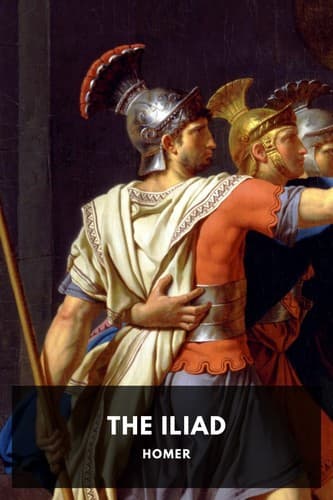
Achilles (Mythological character) -- Poetry; Classical literature; Epic poetry, Greek -- Translations into English; Trojan War -- Poetry
The news of the death of Patroclus is brought to Achilles by
Antilochus. Thetis, hearing his lamentations, comes with all her sea-
nymphs to comfort him. The speeches of the mother and son on this
occasion. Iris appears to Achilles by the command of Juno, and orders
him to show himself at the head of the intrenchments. The sight of him
turns the fortunes of the day, and the body of Patroclus is carried off
by the Greeks. The Trojans call a council, where Hector and Polydamas
disagree in their opinions: but the advice of the former prevails, to
remain encamped in the field. The grief of Achilles over the body of
Patroclus.
Thetis goes to the palace of Vulcan to obtain new arms for her son.
The description of the wonderful works of Vulcan: and, lastly, that
noble one of the shield of Achilles.
The latter part of the nine-and-twentieth day, and the night
ensuing, take up this book: the scene is at Achilles’ tent on the
sea-shore, from whence it changes to the palace of Vulcan.
Thus like the rage of fire the combat burns,[250]
And now it rises, now it sinks by turns.
Meanwhile, where Hellespont’s broad waters flow,
Stood Nestor’s son, the messenger of woe:
There sat Achilles, shaded by his sails,
On hoisted yards extended to the gales;
Pensive he sat; for all that fate design’d
Rose in sad prospect to his boding mind.
Thus to his soul he said: “Ah! what constrains
The Greeks, late victors, now to quit the plains?
Is this the day, which heaven so long ago
Ordain’d, to sink me with the weight of woe?
(So Thetis warn’d;) when by a Trojan hand
The bravest of the Myrmidonian band
Should lose the light! Fulfilled is that decree;
Fallen is the warrior, and Patroclus he!
In vain I charged him soon to quit the plain,
And warn’d to shun Hectorean force in vain!”
Thus while he thinks, Antilochus appears,
And tells the melancholy tale with tears.
“Sad tidings, son of Peleus! thou must hear;
And wretched I, the unwilling messenger!
Dead is Patroclus! For his corse they fight;
His naked corse: his arms are Hector’s right.”
A sudden horror shot through all the chief,
And wrapp’d his senses in the cloud of grief;
Cast on the ground, with furious hands he spread
The scorching ashes o’er his graceful head;
His purple garments, and his golden hairs,
Those he deforms with dust, and these he tears;
On the hard soil his groaning breast he threw,
And roll’d and grovell’d, as to earth he grew.
The virgin captives, with disorder’d charms,
(Won by his own, or by Patroclus’ arms,)
Rush’d from their tents with cries; and gathering round,
Beat their white breasts, and fainted on the ground:
While Nestor’s son sustains a manlier part,
And mourns the warrior with a warrior’s heart;
Hangs on his arms, amidst his frantic woe,
And oft prevents the meditated blow.
Public-domain text, read in full here on John Shaqi.
Reviews
Reviews
No reviews yet
Be the first to share your thoughts on this work.
Elsewhere in the archive
Join the Discussion
Join the discussion
Sign in to leave a comment or review.
Sign InorCreate an account