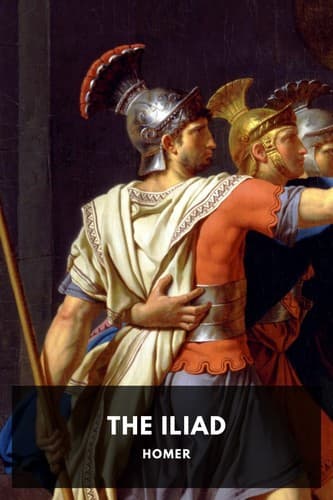
Achilles (Mythological character) -- Poetry; Classical literature; Epic poetry, Greek -- Translations into English; Trojan War -- Poetry
The prince replies: “Ah cease, divinely fair,
Nor add reproaches to the wounds I bear;
This day the foe prevail’d by Pallas’ power:
We yet may vanquish in a happier hour:
There want not gods to favour us above;
But let the business of our life be love:
These softer moments let delights employ,
And kind embraces snatch the hasty joy.
Not thus I loved thee, when from Sparta’s shore
My forced, my willing heavenly prize I bore,
When first entranced in Cranae’s isle I lay,[124]
Mix’d with thy soul, and all dissolved away!”
Thus having spoke, the enamour’d Phrygian boy
Rush’d to the bed, impatient for the joy.
Him Helen follow’d slow with bashful charms,
And clasp’d the blooming hero in her arms.
While these to love’s delicious rapture yield,
The stern Atrides rages round the field:
So some fell lion whom the woods obey,
Roars through the desert, and demands his prey.
Paris he seeks, impatient to destroy,
But seeks in vain along the troops of Troy;
Even those had yielded to a foe so brave
The recreant warrior, hateful as the grave.
Then speaking thus, the king of kings arose,
“Ye Trojans, Dardans, all our generous foes!
Hear and attest! from Heaven with conquest crown’d,
Our brother’s arms the just success have found:
Be therefore now the Spartan wealth restor’d,
Let Argive Helen own her lawful lord;
The appointed fine let Ilion justly pay,
And age to age record this signal day.”
He ceased; his army’s loud applauses rise,
And the long shout runs echoing through the skies.
[Illustration: ] VENUS
[Illustration: ] Map, titled “GRÆCIÆ ANTIQUÆ”
BOOK IV.
ARGUMENT.
THE BREACH OF THE TRUCE, AND THE FIRST BATTLE.
The gods deliberate in council concerning the Trojan war: they agree
upon the continuation of it, and Jupiter sends down Minerva to break
the truce. She persuades Pandarus to aim an arrow at Menelaus, who is
wounded, but cured by Machaon. In the meantime some of the Trojan
troops attack the Greeks. Agamemnon is distinguished in all the parts
of a good general; he reviews the troops, and exhorts the leaders, some
by praises and others by reproof. Nestor is particularly celebrated for
his military discipline. The battle joins, and great numbers are slain
on both sides.
The same day continues through this as through the last book (as it
does also through the two following, and almost to the end of the
seventh book). The scene is wholly in the field before Troy.
And now Olympus’ shining gates unfold;
The gods, with Jove, assume their thrones of gold:
Immortal Hebe, fresh with bloom divine,
The golden goblet crowns with purple wine:
While the full bowls flow round, the powers employ
Their careful eyes on long-contended Troy.
Public-domain text, read in full here on John Shaqi.
Reviews
Reviews
No reviews yet
Be the first to share your thoughts on this work.
Elsewhere in the archive
Join the Discussion
Join the discussion
Sign in to leave a comment or review.
Sign InorCreate an account